soft terns swifts swallows
plovers ascending
rails crakes grebes to earth
harsh bitterns, thrashers and thrushes
surviving as tyrant flycatcher, fisher
of kings, catcher of oysters
woodpecker or spoonbill
behind gentle hummingbird mocking-
bird bunting gallinules
foolish ibis cuckoos and boobies
egged on by coots gannets
the mysterious skua
delicate seedeaters lapwings
osprey melodious new world warblers
sandpipers percussive kites
a militant accompaniment
cardinals troupials martins
a frigatebird cormorant
suspicious guineafowl
weather turning shearwaters
to storm-petrels gulls
indecipherable anis jaegers
tanagers and vireos
at last, nightjars
avocets and stilts
bananaquit after caracaras
doves into silence
typical owls barn owls
heron-still.
Why I write – George Orwell
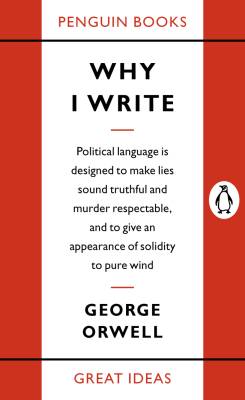 This is Orwell’s answer to that question all writers attempt to answer at some point. It is almost a biography of Orwell’s writing life and interestingly was published a couple of years before his highly influential Ninety Eighty-four.
It’s charming to think of the young Orwell knowing he would grow up to be a writer and spending lonely days making up stories and imagining conversations. Although he can’t quite seem to put his finger on the cause of his compulsion to write as child, he does say “Between the ages of about seventeen and twenty-four I tried to abandon this idea, but I did so with the consciousness that I was outraging my true nature and that sooner or later I should have to settle down and write books.”
He mentions a love of words, which perhaps one must have to be able to work with them, but then in a very Orwellian way, sets out the four great motives that he believes every writer has to some degree:
1. Sheer egoism.
2. Aesthetic enthusiasm.
3.Historical impulse.
4. Political purpose.
No prizes for guessing which was Orwell’s greatest motivation. He elaborates on each of these with reasonable conviction.
The first is about having a desire to prove one’s cleverness and be known and remembered. A desire to live beyond your years, “to get your own back on grown-ups who snubbed you in childhood, etc. etc.”
The second motivation is my favourite. Orwell explains aesthetic enthusiasm as taking pleasure in “the impact of one sound on another, in the firmness of good prose or the rhythm of a good story. Desire to share an experience which one feels is valuable and ought not to be missed.” I feel like this should be a strong motivation to write – especially perhaps poetry – but Orwell says “The aesthetic motive is very feeble in a lot of writers, but even a pamphleteer or a writer of textbooks will have pet words and phrases which appeal to him for non-utilitarian reasons.” !
The historical impulse is about collecting facts, finding out the truth and storing them for posterity. Political purpose, Orwell suggests, is the desire to “push the world in a certain direction, to alter other people’s idea of the kind of society that they should strive after.” Orwell of course was starting to do this already, and went on to have a huge impact on the way people thought about society, manipulation and control with Nineteen Eighty-four. He was clearly thinking a great deal about these concepts in this essay: “I have not written a novel for seven years, but I hope to write another fairly soon. It is bound to be a failure, every book is a failure, but I do know with some clarity what kind of book I want to write.”
Orwell ends his essay somewhat harshly:
Writing a book is a horrible, exhausting struggle, like a long bout of some painful illness. One would never undertake such a thing if one were not driven on by some demon whom one can neither resist nor understand. For all one knows that demon is simply the same instinct that makes a baby squall for attention. And yet it is also true that one can write nothing readable unless one constantly struggles to efface one’s own personality. Good prose is like a windowpane. I cannot say with certainty which of my motives are the strongest, but I know which of them deserve to be followed. And looking back through my work, I see that it is invariably where I lacked a political purpose that I wrote lifeless books and was betrayed into purple passages, sentences without meaning, decorative adjectives and humbug generally.
Tuesday Poem – Honestly
for John Key
I have always believed
we should enhance
the literary skills of our young people
and while our literary heroes
may never challenge the glory
and respect given to our
All Blacks,
we still need role models
to inspire us.
From The Listener
More Tuesday Poems here
And more Political Poetastics here
New Year’s resolution: Gain perspective
 Back on Earth we gauged the pressure, decided it was not strong enough to turn carbon into diamond rain but enough to incite change. We took on new tasks, approached old jobs with renewed determination. After all, we’d made it around the sun again: a revolution to spark a revolution. When we heard all the known matter in the universe could fit into a grain of sand, we took it in our stride; strode across sandy shores anyway, trying not to do the maths. We had been to Titan – a smog-covered moon – we knew what we were getting ourselves into. We laughed too loudly and cried out: If the distance from the sun to Pluto is a ten cent piece then the Milky Way is France!
Bel Canto – by Ann Patchett
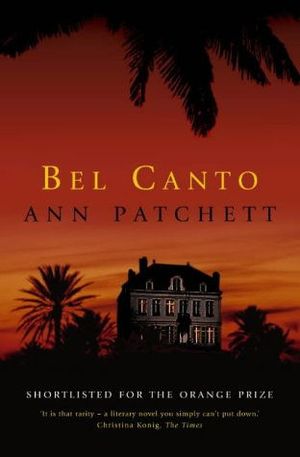 This is an impressive book. Somehow, Ann Patchett manages to create vivid characters with plausible relationships in the most limited of settings.
The novel begins dramatically with terrorists swarming an international gathering, looking for the president of the small Latin American country. But it turns out he stayed home from the party to watch his favourite soap opera and, with no plan B, the terrorists let all but one of the women leave and keep the rest of the group hostage while they figure out what to do. The exception is the famous opera singer Roxane Cox, who proves to be a valuable bargaining tool.
The operatic theme is clever, tying Roxane’s morning singing routine into the relationships that form within the captive group. Convincingly, we lose track of time after a while and the characters quickly lose any desire to escape, accepting the house they originally entered for a birthday party as their new home.
It would be tempting with such a confined setting (both time and space are restricted here) to go into long detailed descriptions of the characters’ lives, as a way to broaden the scope and escape the four walls. But this is never indulged and we begin to care about the characters knowing little about them other than their thoughts and feelings in the immediate situation. Patchett has an amazing skill in using perspective, whereby she effortlessly shifts from one character to another at times within the same paragraph, as if gliding freely among their thoughts.
As in opera so too does this novel end tragically. However, like the captors we have become so swept up in the new life they have created, the inevitable ending comes as quite a shock.
The other thing I particularly loved about this book was the importance of the polyglot, Gen. As this is an international gathering, he becomes invaluable translating firstly the demands of the terrorists, but increasingly as a tool for characters to confess their feelings for each other; declaring love from Russian into English and Japanese to Spanish. But he’s not always required and as Roxane knows, language is not the only way to express oneself.
Tuesday Poem – Ararat
Mass movements form landslide dams
water-logged debris from days of downpour
soil slumps, slides, trees fall to rolling logs.
Mud and earth backed-up to bursting
silty avalanche betrays stacked sand-bags
a saturated story of shifting dirt.
Deluge persists after deluges cease
no need to read the residue
of forests strewn like tealeaves on lawn.
Priorities rise to higher ground
drained and piled the softened land
moulded by unearthly hands.
© Saradha Koirala 2012
more Tuesday Poems here

Gilead – by Marilynne Robinson
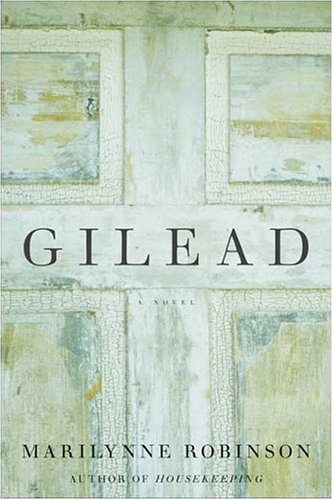 The tone and voice of this book are particularly compelling. Written as an extended letter from a dying father to his son, the meditative style draws the reader in to glimpses of everyday family interactions and the deep and complicated history of the characters’ lives.
Reverend John Ames, narrating from his home in Gilead, links the generations of Ames men through descriptions of their shared vocation and differing understandings of theology. There are certain things he wants his son to know and remember, but also stories that evolve and ramble in a convincingly reminiscent way, all the while with a hint of mystery unfolding.
I loved the father and son relationships in this book and how complicated they became. John Ames Boughton (Jack) is the son of Ames’ best friend, but named as if his own son. His arrival back in town brings out a conflict in Ames, who feels responsible for yet greatly wary of the younger man. He’s clearly hiding something and Ames senses he should be warning his own family of him before he passes on.
The young child to whom the letter is addressed appears in snippets of daily childhood life, playing with his friend Tobias while his father speculates and longs to know about the man he will grow into.
Ideas of faith in this book run deep but somehow gently, as Ames grounds his thoughts in reality and ponders very human questions of life, death and love:
…nothing had prepared me to find myself thinking day and night about a complete stranger, a woman much too young, probably a married woman – that was the first time in my life I ever felt I could be snatched out of my character, my calling, my reputation, as if they could just fall away like a dry husk. I had never felt before that everything I thought I was amounted to the clothes on my back and the books on my shelves and the calendar I kept full of obligations waiting and obligations fulfilled. As I have said, it was a foretaste of death, at least of dying. And why should that seem strange? ‘Passion’ is the word we use, after all.
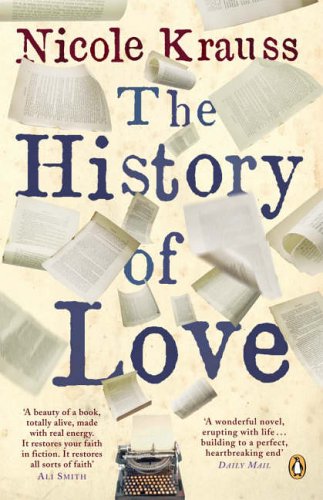
Reading ‘The History of Love’ – by Nicole Krauss
I didn’t have any destination in mind. It started to get dark but I persevered. When I saw a Starbucks I went in and bought a coffee because I felt like a coffee, not because I wanted anyone to notice me. Normally I would have made a big production Give me a Grande Vente, I mean a Tall Grande, Give me a Chai Super Vente Grande, or do I want a Short Frappe? and then for punctuation, I would’ve had a small mishap at the milk station. Not this time. I poured the milk like a normal person, a citizen of the world, and sat down in an easy chair across from a man reading the newspaper. I wrapped my hands around the coffee. The warmth felt good. The next table over there was a girl with blue hair leaning over a notebook chewing on a ballpoint pen, and at the table next to her was a little boy in a soccer uniform sitting with his mother who told him, The plural of elf is elves. A wave of happiness came over me. I felt giddy to be part of it all. To be drinking a cup of coffee like a normal person. I wanted to shout out: The plural of elf is elves! What a language! What a world!
Tuesday Poem – I dream of houses
In less than nine weeks my brother will be a dad.
He’s bigger and smarter and faster than me
rivalry sets me longing
for something of my own.
I think about it one night when I can’t sit still
and clumsy fingers make my violin strings twang.
The roof iron seems to flap loose in a gust
the neighbour’s dog… well.
I think about it when my brother phones
with news of Dad’s heart attack
and the next day when he knocks on my door
bearing brownie and sonograms.
Pictures of my ghostly nephew.
A curved spine highlighted grey
the hollows of a face.
He has a big round belly
that makes us laugh, makes us feel safe.
© Saradha Koirala 2011
more Tuesday Poems here
Tuesday Poem – Ennui by Sylvia Plath
Typescript – final draft
more Tuesday Poems here
 Saradha Koirala