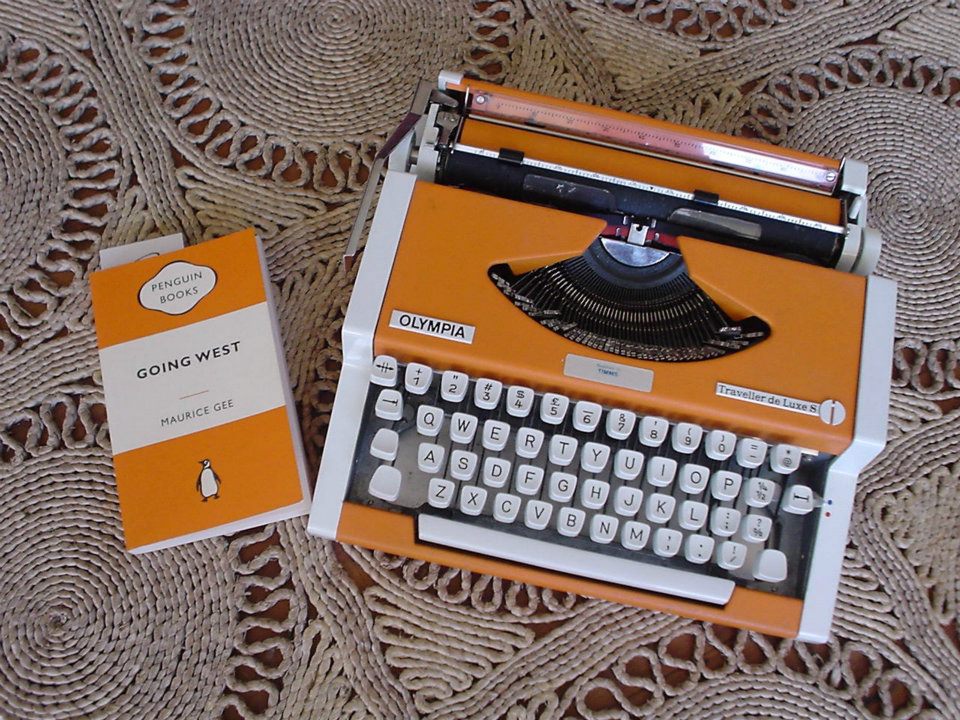
2012 Honoured New Zealand Writer: Maurice Gee – Auckland Writers and Readers Festival

As a 70th birthday present to himself ten years ago, Maurice Gee promised he wouldn’t have to do any more of these festivals, so appearing as the honoured guest at this year’s Auckland Writers and Readers Festival was a big deal for all of us. This is a new initiative devised to celebrate New Zealand’s most accomplished writers, and festival director Anne O’Brien tells us there was no argument that Gee should be the first of these. Gee thought it would be churlish not to accept.

In conversation with Geoff Walker, Gee talks about his childhood and the huge influence of his grandparents and mother on his writing. He recalls his mother warming her feet in the fire while writing stories, some of which went on to be published in the magazines ‘Mirror’ and ‘Women Today’. Her proudest but final literary achievement was having a story selected by Frank Sargeson for publication in an anthology, and Gee believes she could have continued to become a well-known New Zealand author, if life hadn’t got in the way.

Although he’s never been interested in writing an autobiography in the past, Gee admits he is now working on a memoir. His first reading is from this and recalls his early introduction to literature by an elderly friend, Ben Hart. As a young boy, Gee was fascinated by the characters and adventures created by Zane Grey and says he must have read over 40 of his Old West novels. However, as he describes in his reading, he slowly fell in love with Dickens –it took a page to or two to get into.

Walker points out that many of Gee’s novels are in the style of an older person looking back on their life – Plumb of course being the great example of this. It’s well known that the character of George Plumb is heavily based on Gee’s own Grandfather, though he says the first half of Plumb’s life is the same but the second half is fictionalised. Gee had great admiration for his Grandfather as he does for his character. He says that old people have “whole lives” to look back on while they still continue living in the present. He likes to put characters into a situation where something causes them to reflect on the past, while simultaneously having an ordeal to confront in the present. Gee was expecting a question on this and had charmingly prepared a written answer.

The other question he anticipated with written notes was about the sense of darkness in his writing: “People always ask about that.” Having authored over thirty novels for both adults and children, the sense of darkness has emerged again and again for Gee. He sites Browning’s poem “Childe Roland” as a starting point for this fascination, particularly the end where Childe Roland blows the horn from the top of the tower, leaving the reader to decide what is being summoned. Gee says he read this as calling up the darkness that exists within everyone and pictured Childe Roland doing battle with his own sinister self.

The second reading is from Maurice Gee’s own favourite novel, Prowlers (1987). He says of all his older characters, Noel Papps is the most likeable. He reads with vigour the passage after Kate Adams has left with her tape-recorder; Papps both disgusted and fascinated by her.

Historian Rachel Barrowman is currently working with Gee to write his biography. Gee says he’s enjoying this process and is adamant that nothing will be left out. This is intriguing for a man who so rarely appears in public and who until now we have had to piece together through his characters – Jack Skeat of Going West being the closest to an autobiography as we’ve seen. He even requested no audience questions for this event, and admitted to being nervous in public.

But Gee is content and feels a sense of completion. He says that although he maintains a capacity for invention, he feels in his fiction he is now just inventing the same old things over and over and that it’s perhaps imagination that’s lacking. He accepts that Access Road, published in 2009 is his last novel and says “I look back on 30 or so novels and think “that’s ok”.”
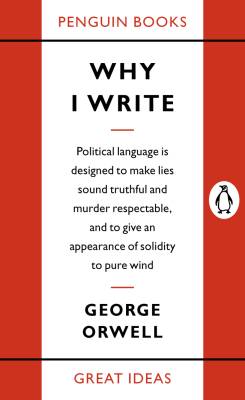
Why I write – George Orwell

This is Orwell’s answer to that question all writers attempt to answer at some point. It is almost a biography of Orwell’s writing life and interestingly was published a couple of years before his highly influential Ninety Eighty-four.

It’s charming to think of the young Orwell knowing he would grow up to be a writer and spending lonely days making up stories and imagining conversations. Although he can’t quite seem to put his finger on the cause of his compulsion to write as child, he does say “Between the ages of about seventeen and twenty-four I tried to abandon this idea, but I did so with the consciousness that I was outraging my true nature and that sooner or later I should have to settle down and write books.”

He mentions a love of words, which perhaps one must have to be able to work with them, but then in a very Orwellian way, sets out the four great motives that he believes every writer has to some degree:

1. Sheer egoism.

2. Aesthetic enthusiasm.

3.Historical impulse.

4. Political purpose.

No prizes for guessing which was Orwell’s greatest motivation. He elaborates on each of these with reasonable conviction.

The first is about having a desire to prove one’s cleverness and be known and remembered. A desire to live beyond your years, “to get your own back on grown-ups who snubbed you in childhood, etc. etc.”

The second motivation is my favourite. Orwell explains aesthetic enthusiasm as taking pleasure in “the impact of one sound on another, in the firmness of good prose or the rhythm of a good story. Desire to share an experience which one feels is valuable and ought not to be missed.” I feel like this should be a strong motivation to write – especially perhaps poetry – but Orwell says “The aesthetic motive is very feeble in a lot of writers, but even a pamphleteer or a writer of textbooks will have pet words and phrases which appeal to him for non-utilitarian reasons.” !

The historical impulse is about collecting facts, finding out the truth and storing them for posterity. Political purpose, Orwell suggests, is the desire to “push the world in a certain direction, to alter other people’s idea of the kind of society that they should strive after.” Orwell of course was starting to do this already, and went on to have a huge impact on the way people thought about society, manipulation and control with Nineteen Eighty-four. He was clearly thinking a great deal about these concepts in this essay: “I have not written a novel for seven years, but I hope to write another fairly soon. It is bound to be a failure, every book is a failure, but I do know with some clarity what kind of book I want to write.”

Orwell ends his essay somewhat harshly:

Writing a book is a horrible, exhausting struggle, like a long bout of some painful illness. One would never undertake such a thing if one were not driven on by some demon whom one can neither resist nor understand. For all one knows that demon is simply the same instinct that makes a baby squall for attention. And yet it is also true that one can write nothing readable unless one constantly struggles to efface one’s own personality. Good prose is like a windowpane. I cannot say with certainty which of my motives are the strongest, but I know which of them deserve to be followed. And looking back through my work, I see that it is invariably where I lacked a political purpose that I wrote lifeless books and was betrayed into purple passages, sentences without meaning, decorative adjectives and humbug generally.

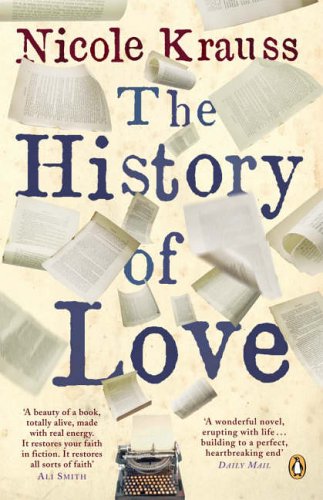
Reading ‘The History of Love’ – by Nicole Krauss

I didn’t have any destination in mind. It started to get dark but I persevered. When I saw a Starbucks I went in and bought a coffee because I felt like a coffee, not because I wanted anyone to notice me. Normally I would have made a big production Give me a Grande Vente, I mean a Tall Grande, Give me a Chai Super Vente Grande, or do I want a Short Frappe? and then for punctuation, I would’ve had a small mishap at the milk station. Not this time. I poured the milk like a normal person, a citizen of the world, and sat down in an easy chair across from a man reading the newspaper. I wrapped my hands around the coffee. The warmth felt good. The next table over there was a girl with blue hair leaning over a notebook chewing on a ballpoint pen, and at the table next to her was a little boy in a soccer uniform sitting with his mother who told him, The plural of elf is elves. A wave of happiness came over me. I felt giddy to be part of it all. To be drinking a cup of coffee like a normal person. I wanted to shout out: The plural of elf is elves! What a language! What a world!

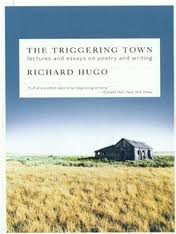
Writing off the Subject – Richard Hugo (from ‘The Triggering Town’)

One thing I really liked about this essay was the idea that whatever images or ideas evolve as a poem is being written will be connected together purely because they have come from the same mind. Hugo says:

When you are writing you must assume that the next thing you put down belongs not for reasons of logic, good sense, or narrative development, but because you put it there…The adhesive force is your way of writing, not sensible connection.

This seemed useful, as I often write poems by collecting images until I see a poem in them, meaning they don’t necessarily follow or tell the same story.

Hugo also wrote about ‘the truth’ and its place in poetry. I liked the idea that if the subject is yellow but it would sound better in the poem if it were black, then those facts can be changed for the sake of the poem. “You owe reality nothing and the truth about your feelings everything.”

This leads into the idea of using words for the sake of sound and ‘getting off the subject’, which Hugo suggests often gets in the way of actually writing the poem. Sometimes a connection can be made for meaning, even if the original choice of words was sound based.

Hugo also talks about writing without the reader in mind. “There is no reader.” And we talked about this as a class. I think this is an especially hard thing to remember in the context of a workshop, as we are all aware that we do have an audience and we know exactly who that audience is! It’s very different from writing and thinking ‘maybe no one will ever read this’, which I admit is quite freeing.

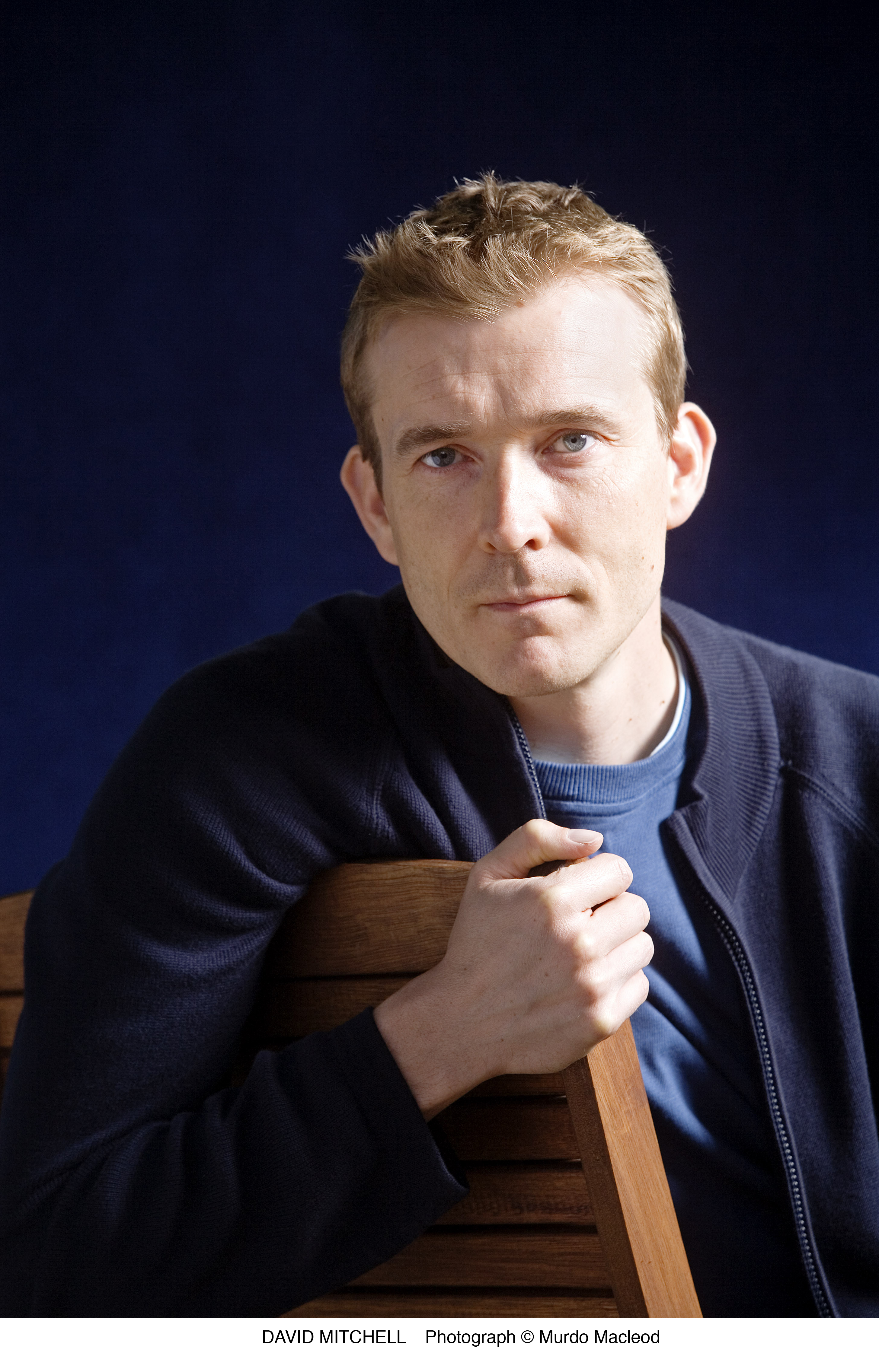
‘An Hour with David Mitchell’ Auckland Writers and Readers Festival– 14th May 2011

“Gulls wheel through spokes of sunlight over gracious roofs and dowdy thatch, snatching entrails at the marketplace and escaping over cloistered gardens, spike topped walls and treble-bolted doors. Gulls alight on whitewashed gables, creaking pagodas and dung-ripe stables; circle over towers and cavernous bells and over hidden squares where urns of urine sit by covered wells, watched by mule-drivers, mules and wolf-snouted dogs, ignored by hunch-backed makers of clogs; gather speed up the stoned-in Nakashima River and fly beneath the arches of its bridges, glimpsed from kitchen doors, watched by farmers walking high, stony ridges. … over the roof of a painter withdrawn first from the world, then his family, and down into a masterpiece that has, in the end, withdrawn from its creator; and around again, where their flight began, over the balcony of the Room of the Last Chrysanthemum, where a puddle from last night’s rain is evaporating; a puddle in which Magistrate Shiroyama observes the blurred reflections of gulls wheeling through spokes of sunlight. This world, he thinks, contains just one masterpiece, and that is itself.

David Mitchell starts his hour with us by reading this passage from chapter XXXIX of The Thousand Autumns of Jacob de Zoet. Having not yet made it to this part of the book myself, I instantly grow determined to persevere with what I’m finding to be a demanding yet rewarding read.

I’ve flown up from Wellington with a clammy handful of questions to ask about writing, narrative and genre but also with acceptance that being in the same room as a literary master will be inspiring enough.

There’s little time to linger on the last line of his first reading, but enough to make the connection that Mitchell is far too humble to ever suggest he his creating masterpieces. He lets us applaud and release our held breath before confessing he’s completely sick of his latest book and wants to read us something entirely new.

A short story, An Inside Job, which he says is also an excerpt from the novel he’s writing at the moment. It appears to be a return to family oriented stories with a split marriage, jealous father and somewhat precocious-sounding young son. It also seems to be set in Worcestershire – perhaps a return to Black Swan Green?

Emily Perkins asks the thoughtful questions of a well-read Mitchell fan and the audience quickly tune into the humour and humility of our guest. He talks a lot about The Thousand Autumns, which – as a historical novel – sounds like a huge amount of work went into researching and crafting a sense of authenticity. As the novel explores different cultures and language, Mitchell says the great difficulty came in creating a plausible voice for all his characters that wasn’t “too authentic.” Twenty-first Century readers need to believe in the language of the characters but if it’s too real it starts to “sound like Blackadder.” Instead, Mitchell had to create what he called a kind of “bygonese” – language that we accept to be of a certain era.

Again and again David Mitchell shows us that he loves to talk about writing but in no way does he at all assume we’ve read his work. A fair assumption it would have been too, given the size and calibre of the crowd.

When asked about his writing process, Mitchell describes his ideas for novels as always there circling “like aircraft in holding patterns, waiting for their turn to land.” So no writer’s block then? He says he became anxious to finish The Thousand Autumns so he could get on with the next two novels, which he has a clear sense of already.

Perhaps the opposite of writer’s block then? A flood-gate of sorts. He admits that he is “wildly over-ambitious” with all his writing ideas, creating “literary cathedrals” that collapse under their own weight. The novels themselves come out of the “rubble” or the bits and pieces that survive the crash, “palimpsests” echoes and memories of the grand ideas they began as. Surely a self-deprecating remark but it does seem likely when looking at the structure of all his work: pieces stacked and rebuilt, connected by tough thread. He quotes Alan Bennett’s “Style is the sum of one’s imperfections,” suggesting that any mistakes he makes, he makes his own.

Hearing writers talk about the writing process is enlightening. As a reader and teacher of David Mitchell’s books (my Year 13 class are studying Black Swan Green as we speak), unpacking the creative mind is not necessary to the enjoyment of the novels but it certainly adds to it. Mitchell says, of the five elements of a novel – plot, character, structure, style, theme – he always starts with the plot and character; ideas evolve as he writes. He says it’s important to get plot and character right, but novels need to have ideas too. For example, the idea of ‘miscommunication’ became interesting as he researched and wrote The Thousand Autumns, but it was not where he started. He says all novels end up having a few “default themes” such as ‘memory’ or ‘freewill’, even if that’s not what they’re trying to be about. ‘Story’ is always about remembering and trying to pin down a kind of truth and when creating characters it’s inevitable to start thinking about who’s really in control.

But the idea of ‘miscommunication’ is pertinent and seems to run through many of his novels: Jason in Black Swan Green stammers and can only really express himself secretly in his poetry; Ghostwritten has a transmigrating soul trying to be heard, as well as characters who hide, are blind or are merely voice. In Cloud Atlas, miscommunications are deadly. Perhaps this comes from Mitchell’s own speech impediment and the effort he has had to go to to communicate. As a stammerer, he has said he must think further ahead in the conversation than most people to see what words he will need to replace, resulting in him having a deeper understanding of language and speech than other writers. His most self-assured moment comes when he admits he is very good at writing dialogue and creating convincing character voices.

Mitchell’s reasons for writing seem to be standard, and maybe we shouldn’t ask people who do something so brilliantly why they do it. It certainly sounds as though he has to write – with so many ideas circling above his airport-brain, but, like many writers, he is fascinated by the power of story and how dependent we are on narrative to help us make sense of the world. However, when asked about his own story, he says he’s never been that interested in it but more the “common denominators between all our stories” which therefore becomes “the human story.” This might explain why his first three novels do not hint at his own life at all and he says he didn’t want to write about himself until he started his own family and became more interested in domestic life. Black Swan Green was written as Mitchell became fascinated by the constant “changing gear shifts of marriage” and started to think about his own beginnings.

When asked about his influences, Mitchell says he also writes because he “aches” to make people feel the way he has felt reading some of his favourite writers. However, he dismisses these as influences and spoke more of an aspiration to be as good as the writers he loved as a kid.

The hour is up before I get to ask my own question, but I feel he’s answered so much more. It’s not just being in the presence of a great mind that’s awe-inspiring, it’s being part of the conversation, adding to our collective human story.

The Poet and “I”

…the lyric poet’s images are nothing but the poet himself, and only different objectifications of himself, which is why, as the moving centre of that world, he is able to say “I”: this self is not that of the waking, empirically real man, however, but rather the sole, truly existing and eternal self that dwells at the base of being, through whose depictions the lyric genius sees right through to the very basis of being
– Nietzsche

Poetry is not a turning loose of emotion, but an escape from emotion; it is not the expression of personality, but an escape from personality. But, of course, only those who have personality and emotions know what it means to want to escape these things
– T.S Eliot

Poetry, the creative process and mental illness

By Alex Hudson
BBC NEWS

7 February 2011 Last updated at 10:29 GMT

Byron was “mad, bad and dangerous to know” according to one lover, Keats was driven to distraction by obsessive love and Sylvia Plath ended her own life.

Depression, madness and insanity are themes which have run throughout the history of poetry.

The incidence of mood disorders, suicide and institutionalisation was 20 times higher among major British and Irish poets between 1600 and 1800 according to a study by psychologist Kay Redfield Jamison.

In other words, poets are 20 times more likely to end up in an asylum than the general population.

Science has puzzled to explain it. One recent study found similar brain patterns in artists at work to those of schizophrenics. Another study found that creative graduates share more personality traits with bipolar patients than less creative ones.

As far back as the mid 1800s, Emily Dickinson stated that “much madness is Divinest sense” and Edgar Allan Poe questioned “whether madness is or is not the loftiest intelligence”. 

 So what is it about poetry that seems to attract those more likely to suffer a mental disorder?

“If you’re a creative person, then poetry is a great format because it’s short,” says poet Luke Wright. “You can do almost anything with it and it’s not like a novel – it’s not going to take you years and you have no idea if it’s going to be any good.”

Poetry allows for the nuance of language and the different way someone sees the world.

“I think you’ve always got to be interested in a slightly different aspect of the universe to even want to pick up a pen and analyse the world through poetry,” says spoken word artist Laura Dockrill.

“I think our brains are big scribbles and always active. Because you can write about anything, you’re always on the go – trying to put something to your Velcro head hoping it will stick on.

“Part of poetry is making words do more work that they usually should do and so you’re looking for every angle of what a word might mean and so your brain starts working like as well – over-analysing everything and zooming in to minute detail.”

Read More

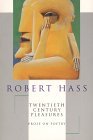
Twentieth-Century Pleasures – Robert Hass

Hass’ essays are amazing. He obviously loves what he’s talking about and often brings in life experience and family to illustrate his points.

In the essay ‘Images’ Hass looks at Haiku. Haiku seems to be the ultimate image-based poetry (even though form is also very important). The essay starts by looking at evidence of family activity: The towels drying on the fence, the note left by the daughter. These are images that are full of meaning to Hass as a parent but he says:

I had written about beach towels drying on a fence at the end of August in the early morning heat. I think it pleased me as much as anything I wrote last year, but I knew that it had seemed slight to everyone who had seen it. I had somehow not gotten it right.

Hass’ honesty in his own failing is endearing. He goes on to suggest that if he’d taken the image to Basho, he would have been accused of trying too hard to say unusual things.

This is something to keep in mind about images: is the image still interesting out of context? I feel that this image for Hass is loaded with family and holiday; an understanding that readers do not necessarily associate with towels drying on a fence.

But then it is these associations that give images more power. Hass talks about a Buson poem:

Apprentice’s holiday:
hops over kite string,
keeps going.

It is important to know that Apprentice’s holiday is associated with kite-flying and that it was a day people learning trades were given to go and visit family. Knowing this makes the action of hopping over the string and carrying on (presumably to visit family) so purposeful, and the way the string is tight suggests a whole image of the flying kite – even though we never see the kite. Similar associations can be made in Haiku as the seasons are often suggested by the colour of things: yellowing fields, blossom, snow and so forth.

‘One Body: Some Notes on Form’ again starts with a family memory. The essay is concerned with how form works with intention in poetry to create a sense or feeling. Hass writes “I am thinking of the form of a poem, the shape of its understanding. The presence of that shaping constitutes the presence of poetry.” He says it is not the tone, image or qualities of the content that create or shape the poem into existence, but form.

I found this essay so interesting and quite complicated. I’m not sure I totally understand form in this sense, as it is different to using rhythm or sound-making. I am, however, thinking quite consciously about form in terms of how a poem feels and looks on the page. If the poem is set in a wide landscape, I try to give the poem the space to fill this, often with longer lines and shorter stanzas.

Another thing I’m interested in is rhythm. In ‘Listening and Making’, Hass talks about the purpose of rhythm and how patterns can be made and broken according to content and theme. He writes that it is not the syllables or length of a line, but the amount of stresses that creates the rhythm. He looks at some cases where the pattern is created by stresses and pauses and then inverted at the end. For example, the metric pattern of Yeats’ lines

When you are OLD and GREY/ and FULL of SLEEP

And NODding by the FIRE,/ TAKE DOWN this BOOK

And SLOWly READ,/ and DREAM of the SOFT LOOK

Your EYES HAD ONCE,/ and of their SHAdows DEEP.

is

2/2

2/3

2/3

3/2

where the pattern is reversed in last line. Hass says “Life and death, odd and even are the terms of play.” I find this fascinating that the rhythm would be so connected with the themes of this poem. I wonder how consciously the poet creates and distorts these patterns or if it is something that just sounds right in the writing. It does seem that there should be a physical shift in the poem if the poem has shifted to a different place thematically. Often it is the change in rhythm that alerts the change in tone.

Line length is important when looking at rhythm, so that a line does not carry too many pauses, which could drag. In this sense, line breaks should occur where the stresses fit, and not necessarily where length, content or syllables are concerned.

Form and function appear crucial when looking at poetry this way. And why not? A poem should surely be created meaningfully with images, rhythm and form that suit the purpose and add up to its shaping and coming into being.


Why we write – part 2

Here are some quotes from my Creative Writing class expressing what we love about writing – inspiring stuff!

When life gets you down, write your way back up.

Words are your mind; your mind is whatever you wish.

Getting stuck sometimes gives you the best ideas.

An idea for a story is like an unexpected visitor: you don’t want it to leave, but where shall you put it?

The challenge of being an author is making the make-believe seem real.

Poetry is just the end of the road – it’s what you discover on the journey that counts.

Your life is a story – write it!

Poetry is like a light leading you to the full story.

Writing is like something I can’t explain – the rush of pen across paper creating magical new places and characters or portraying your feelings is something you should not miss.

If you can’t eat, sleep or talk, write.

Why we write

I am compiling a list of inspirational quotes for my Creative Writing students. Their task will be to try and write their own or sum-up why they love to write.

There are no rules of architecture for a castle in the clouds. – Gilbert K. Chesterton

The only thing that can save the world is reclaiming the awareness of the world. That’s what poetry does.– Allen Ginsberg.

Poetry is just the evidence of life. If your life is burning well, poetry is just the ash.– Leonard Cohen

A fact is not a truth until you love it.– John Keats

There’s nothing to writing. All you do is sit down at a typewriter and open a vein.~Walter Wellesley “Red” Smith

The two most engaging powers of an author are to make new things familiar and familiar things new.
~Samuel Johnson

I write entirely to find out what I’m thinking, what I’m looking at, what I see and what it means. What I want and what I fear.
– Joan Didion