Tuesday Poem – Makara (for Flash Fiction Week)

First we note the smell: kelp and dead sea creatures, particularly pungent on this rare still day and late morning enough to have percolated in thin sun. Cars glisten like the water lined up like lapped waves around the shore, around the edge of the island as if this is as far as you can go by vehicle – even an all-terrain – if you want to go further you’d better have the right shoes.

My shoes of course have holes and David’s in jandals – “flip-flops” he calls them, as if he can’t stand the kiwism like he can’t stand the accent. Older couples have the right idea though, much more prepared, or prepared for something much more – worn-in hiking boots and wind-breakers, backpacks filled with water bottles probably, maybe an apple each and a spare pair of socks.

Rocks are rounded but we can feel each one under foot. We take the less steep side up, plan to follow the ridge back but slight slip – edge slowly back down. The café does not impress so we press on, end up in Kelburn, goose-bumped but well-dressed for long back, flat white a section of Sunday paper.


More Flash Fiction at the Tuesday Poem hub

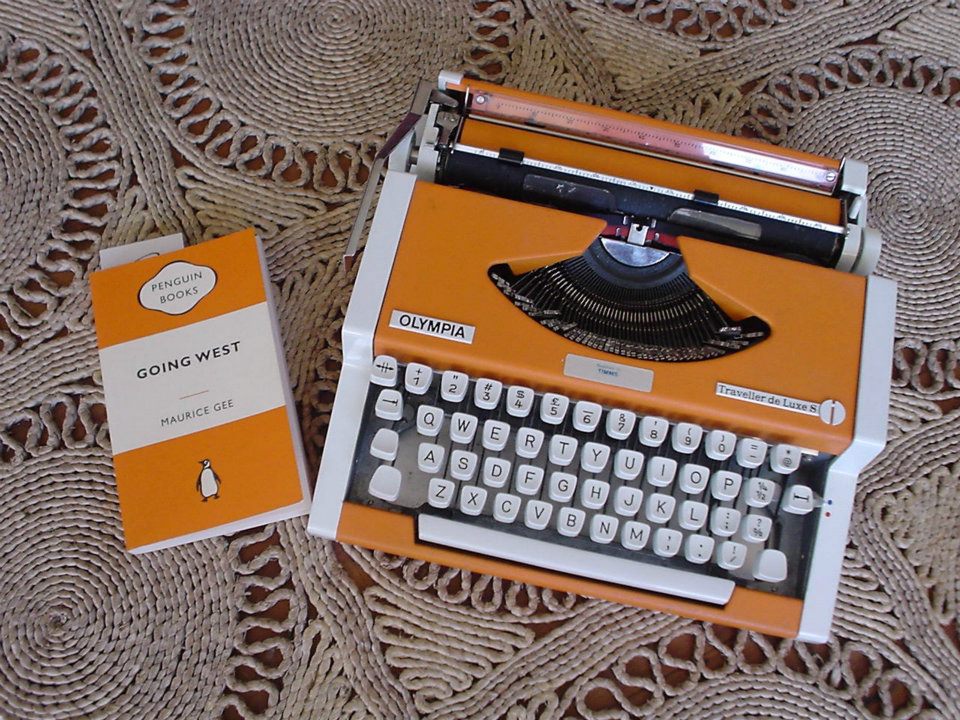
2012 Honoured New Zealand Writer: Maurice Gee – Auckland Writers and Readers Festival

As a 70th birthday present to himself ten years ago, Maurice Gee promised he wouldn’t have to do any more of these festivals, so appearing as the honoured guest at this year’s Auckland Writers and Readers Festival was a big deal for all of us. This is a new initiative devised to celebrate New Zealand’s most accomplished writers, and festival director Anne O’Brien tells us there was no argument that Gee should be the first of these. Gee thought it would be churlish not to accept.

In conversation with Geoff Walker, Gee talks about his childhood and the huge influence of his grandparents and mother on his writing. He recalls his mother warming her feet in the fire while writing stories, some of which went on to be published in the magazines ‘Mirror’ and ‘Women Today’. Her proudest but final literary achievement was having a story selected by Frank Sargeson for publication in an anthology, and Gee believes she could have continued to become a well-known New Zealand author, if life hadn’t got in the way.

Although he’s never been interested in writing an autobiography in the past, Gee admits he is now working on a memoir. His first reading is from this and recalls his early introduction to literature by an elderly friend, Ben Hart. As a young boy, Gee was fascinated by the characters and adventures created by Zane Grey and says he must have read over 40 of his Old West novels. However, as he describes in his reading, he slowly fell in love with Dickens –it took a page to or two to get into.

Walker points out that many of Gee’s novels are in the style of an older person looking back on their life – Plumb of course being the great example of this. It’s well known that the character of George Plumb is heavily based on Gee’s own Grandfather, though he says the first half of Plumb’s life is the same but the second half is fictionalised. Gee had great admiration for his Grandfather as he does for his character. He says that old people have “whole lives” to look back on while they still continue living in the present. He likes to put characters into a situation where something causes them to reflect on the past, while simultaneously having an ordeal to confront in the present. Gee was expecting a question on this and had charmingly prepared a written answer.

The other question he anticipated with written notes was about the sense of darkness in his writing: “People always ask about that.” Having authored over thirty novels for both adults and children, the sense of darkness has emerged again and again for Gee. He sites Browning’s poem “Childe Roland” as a starting point for this fascination, particularly the end where Childe Roland blows the horn from the top of the tower, leaving the reader to decide what is being summoned. Gee says he read this as calling up the darkness that exists within everyone and pictured Childe Roland doing battle with his own sinister self.

The second reading is from Maurice Gee’s own favourite novel, Prowlers (1987). He says of all his older characters, Noel Papps is the most likeable. He reads with vigour the passage after Kate Adams has left with her tape-recorder; Papps both disgusted and fascinated by her.

Historian Rachel Barrowman is currently working with Gee to write his biography. Gee says he’s enjoying this process and is adamant that nothing will be left out. This is intriguing for a man who so rarely appears in public and who until now we have had to piece together through his characters – Jack Skeat of Going West being the closest to an autobiography as we’ve seen. He even requested no audience questions for this event, and admitted to being nervous in public.

But Gee is content and feels a sense of completion. He says that although he maintains a capacity for invention, he feels in his fiction he is now just inventing the same old things over and over and that it’s perhaps imagination that’s lacking. He accepts that Access Road, published in 2009 is his last novel and says “I look back on 30 or so novels and think “that’s ok”.”
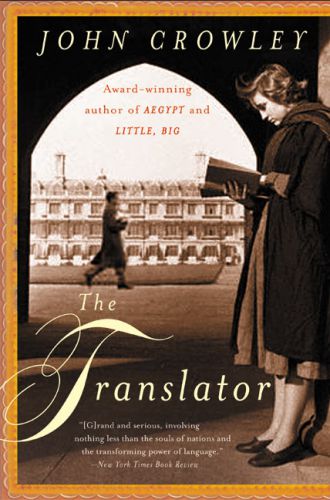
The Translator – by John Crowley

As you know, I love books about poets and the power of language. This book won me over on the second page with reference to Shelley’s famous ‘defence of poetry’: Poets are the unacknowledged legislators of the world. (“of the world!” the main character exclaims later.)

Set in the time of the Cuban missile crisis, poetry and politics are vying for power. Kit Malone attends college in the midwest with missile silos nearby and exiled Russian poet, Falin as her teacher. The novel follows the development of their relationship through Kit’s translations of his poetry and their growing love for each other.

The politics of the time is conveyed through the secrecy of the government – the mysterious Milton Bluhdorn asking questions about Falin’s whereabouts – the radical student groups that form and the tragic reality of Kit’s brother joining the armed forces. Falin tells Kit about his childhood in Russia as an orphan and when she lends him Through the Looking Glass, he seems to relate to Alice’s surreal journey from childhood and being in a world of opposites:

When I read I believed I discovered a flaw in it: would it not be impossible for Alice to pass through the mirror? She would I thought only kiss herself there: face to face, hand to hand, breast to breast. How to pass through? Then I saw, no, this is supreme genius of the book: that if Alice passes through her mirror, then Alice from the other side must also pass through; and while we read interesting adventures of Alice in her mirror, at the same time there is another story not told, the adventures of mirror-Alice here, where she does not belong, strange world where clocks run only one way and you cannont tell red kings from white.

These two ‘selves’ of Falin are evident too, when he discusses with Kit the impossiblity of translating a poem. He insists that translations of his poetry are no longer his and a new poem has been born that could never capture the nuances of the original language (in Russian, Freedom, volya rhymes with Fate, dolya) Therefore, when he asks Kit to translate his Russian poems into English, she soon realises that it’s not a way of preserving his poems but a way for her to create her own work and let go of what she sees as the dangers of writing.

Tuesday Poem – Birds of Anguilla

soft terns  swifts  swallows
plovers ascending
rails  crakes  grebes to earth
harsh bitterns, thrashers and thrushes
surviving as tyrant flycatcher, fisher
of kings, catcher of oysters
woodpecker or spoonbill
behind gentle hummingbird mocking-
bird  bunting  gallinules
foolish ibis  cuckoos and boobies
egged on by coots  gannets
the mysterious skua
delicate seedeaters  lapwings
osprey  melodious new world warblers
sandpipers  percussive kites
a militant accompaniment
cardinals  troupials  martins
a frigatebird  cormorant
suspicious guineafowl
weather turning shearwaters
to storm-petrels  gulls
indecipherable anis  jaegers
tanagers and vireos
at last, nightjars
avocets and stilts
bananaquit after caracaras
doves into silence
typical owls  barn owls
heron-still.

more Tuesday Poems here

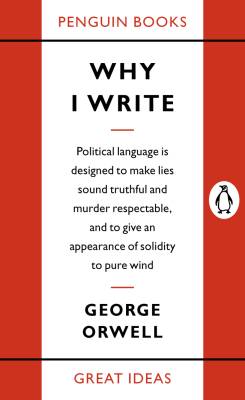
Why I write – George Orwell

This is Orwell’s answer to that question all writers attempt to answer at some point. It is almost a biography of Orwell’s writing life and interestingly was published a couple of years before his highly influential Ninety Eighty-four.

It’s charming to think of the young Orwell knowing he would grow up to be a writer and spending lonely days making up stories and imagining conversations. Although he can’t quite seem to put his finger on the cause of his compulsion to write as child, he does say “Between the ages of about seventeen and twenty-four I tried to abandon this idea, but I did so with the consciousness that I was outraging my true nature and that sooner or later I should have to settle down and write books.”

He mentions a love of words, which perhaps one must have to be able to work with them, but then in a very Orwellian way, sets out the four great motives that he believes every writer has to some degree:

1. Sheer egoism.

2. Aesthetic enthusiasm.

3.Historical impulse.

4. Political purpose.

No prizes for guessing which was Orwell’s greatest motivation. He elaborates on each of these with reasonable conviction.

The first is about having a desire to prove one’s cleverness and be known and remembered. A desire to live beyond your years, “to get your own back on grown-ups who snubbed you in childhood, etc. etc.”

The second motivation is my favourite. Orwell explains aesthetic enthusiasm as taking pleasure in “the impact of one sound on another, in the firmness of good prose or the rhythm of a good story. Desire to share an experience which one feels is valuable and ought not to be missed.” I feel like this should be a strong motivation to write – especially perhaps poetry – but Orwell says “The aesthetic motive is very feeble in a lot of writers, but even a pamphleteer or a writer of textbooks will have pet words and phrases which appeal to him for non-utilitarian reasons.” !

The historical impulse is about collecting facts, finding out the truth and storing them for posterity. Political purpose, Orwell suggests, is the desire to “push the world in a certain direction, to alter other people’s idea of the kind of society that they should strive after.” Orwell of course was starting to do this already, and went on to have a huge impact on the way people thought about society, manipulation and control with Nineteen Eighty-four. He was clearly thinking a great deal about these concepts in this essay: “I have not written a novel for seven years, but I hope to write another fairly soon. It is bound to be a failure, every book is a failure, but I do know with some clarity what kind of book I want to write.”

Orwell ends his essay somewhat harshly:

Writing a book is a horrible, exhausting struggle, like a long bout of some painful illness. One would never undertake such a thing if one were not driven on by some demon whom one can neither resist nor understand. For all one knows that demon is simply the same instinct that makes a baby squall for attention. And yet it is also true that one can write nothing readable unless one constantly struggles to efface one’s own personality. Good prose is like a windowpane. I cannot say with certainty which of my motives are the strongest, but I know which of them deserve to be followed. And looking back through my work, I see that it is invariably where I lacked a political purpose that I wrote lifeless books and was betrayed into purple passages, sentences without meaning, decorative adjectives and humbug generally.