Tuesday Poem – House-hunting (a found poem)

Well-presented, dramatic flair
lovely outlook downtown and debonair!

Sunny and sophisticated, stunning views
flowing space, light and airy rooms.

Charming contemporary-classical feeling
fantastic sun, stunningly appealing.

Landscaped enclosed well-proportioned haven
separate dining, convenient location.

An absolute suntrap! Fully fenced!
Quintessential elegance.

www.tommys.co.nz

more Tuesday Poems here

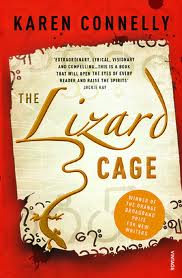
The Lizard Cage – by Karen Connelly

I found this to be an amazing read. I got to the end – crouched and anxious – and went straight back to read the beginning again.

Teza is a political prisoner in solitary confinement during Burma’s turmoil of the mid-1990s. He gleans scraps of information about the outside world wherever he can and remains dignified through Buddhist patience and by upholding the precepts. Before his imprisonment, Teza used anti-dictatorship songs to influence those around him; while in the cage he continues to inspire those who come near him with his forbearance.

Connelly’s vivid, lyrical writing is riveting. Having spent some time in Burma (Myanmar) she is able to give the real and gruesome details of the harrowing setting, but her language maintains beauty.

“Little Brother” the young boy Teza befriends serves as both a symbol of hope and a tragic illustration of the lowliness of prison-life and a people who have lost control.

This is an inspiring look into what it means to be free and how vital it is to make human connections. Teza’s ritual dissection of the cheroot cigars reinforces this again through the importance of words:

“After eating and meditating, the cheroot ceremony is the most important event in his life. It is a challenge to perform it well. To peel the filters apart slowly enough is an act of discipline.

The filters are made with rigid, dried straw. Holding the filters tight is a band of newspaper.

Words.”

He takes the scraps of writing and lines them up, creating a story for himself. It is a contraband pen that causes the most violent and distressing events for Teza and Little Brother, but before this, reading the pieces of newspaper, Teza realises

“As long as there is paper, people will write, secretly, in small rooms, in the hidden chambers of their minds, just as people whisper the words they’re forbidden to speak aloud. The generals can’t stop them. Ne Win himself can’t stop them. He never could. Words are like the ants. They work their way through the thickest walls, eating through bricks and feeding off the very silence intended to stifle them.”

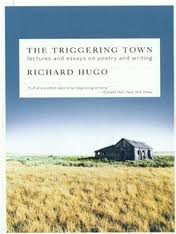
Writing off the Subject – Richard Hugo (from ‘The Triggering Town’)

One thing I really liked about this essay was the idea that whatever images or ideas evolve as a poem is being written will be connected together purely because they have come from the same mind. Hugo says:

When you are writing you must assume that the next thing you put down belongs not for reasons of logic, good sense, or narrative development, but because you put it there…The adhesive force is your way of writing, not sensible connection.

This seemed useful, as I often write poems by collecting images until I see a poem in them, meaning they don’t necessarily follow or tell the same story.

Hugo also wrote about ‘the truth’ and its place in poetry. I liked the idea that if the subject is yellow but it would sound better in the poem if it were black, then those facts can be changed for the sake of the poem. “You owe reality nothing and the truth about your feelings everything.”

This leads into the idea of using words for the sake of sound and ‘getting off the subject’, which Hugo suggests often gets in the way of actually writing the poem. Sometimes a connection can be made for meaning, even if the original choice of words was sound based.

Hugo also talks about writing without the reader in mind. “There is no reader.” And we talked about this as a class. I think this is an especially hard thing to remember in the context of a workshop, as we are all aware that we do have an audience and we know exactly who that audience is! It’s very different from writing and thinking ‘maybe no one will ever read this’, which I admit is quite freeing.

Tuesday Poem – Too Early(?)

This strange building, park-lined
porched with old couches
shadowed by (whispered with) new bamboo
do you see?
You blow me kisses from doorways
and I extend the metaphor to breaking point.

Did you promise to check for submerged logs,
those floating branches,
before I jumped in?
Or did
you promise they wouldn’t  (to) be there?
(Or did you make sure to make clear
that you’d made no promise at all?)

You blow me kisses from doorways
from bus stops, the driveway
as I marvel at what the soles of my shoes can endure.
I wear yesterday’s clothes.
You blow me kisses from doorways
say no regrets but no guarantees
love but not
‘in love’.

I step in butter, I step in squashed fruit.
I try to (can) be the shadow of the bird on the branch
of the tree that I lie beneath.
But I remain like this.

You blow me kisses from doorways
and the back lawn struggles
to release
a shimmering moment of bees.

© Saradha Koirala 2011

more Tuesday Poems here

Happy Poetry Day!

Poetry day

from Wit of the staircase

When an Argentinean rugby team played the high school team at lunchtime, the English teachers had a poetry party.  All morning the librarians were busy inflating balloons and writing verses on them in vivid. We sat in a circle and read poems to each other, but when the deputy principal said “poetry is about words not ideas,” we argued.

A seventh former came and read something he’d just written, with a rhyming couplet at the end – “a shout out to my man Seamus Heaney.”

The rugby game went on long into fourth period, so I drifted into The Book of Clouds. I found Altocumulus, like a conjurer’s word and the glory effect is magic.


Tuesday Poem – by Wallace Stevens

Thirteen Ways of Looking at a Blackbird

I
Among twenty snowy mountains,
The only moving thing
Was the eye of the blackbird.

II
I was of three minds,
Like a tree
In which there are three blackbirds.

III
The blackbird whirled in the autumn winds.
It was a small part of the pantomime.

IV
A man and a woman
Are one.
A man and a woman and a blackbird
Are one.

V
I do not know which to prefer,
The beauty of inflections
Or the beauty of innuendoes,
The blackbird whistling
Or just after.

VI
Icicles filled the long window
With barbaric glass.
The shadow of the blackbird
Crossed it, to and fro.
The mood
Traced in the shadow
An indecipherable cause.

VII
O thin men of Haddam,
Why do you imagine golden birds?
Do you not see how the blackbird
Walks around the feet
Of the women about you?

VIII
I know noble accents
And lucid, inescapable rhythms;
But I know, too,
That the blackbird is involved
In what I know.

IX
When the blackbird flew out of sight,
It marked the edge
Of one of many circles.

X
At the sight of blackbirds
Flying in a green light,
Even the bawds of euphony
Would cry out sharply.

XI
He rode over Connecticut
In a glass coach.
Once, a fear pierced him,
In that he mistook
The shadow of his equipage
For blackbirds.

XII
The river is moving.
The blackbird must be flying.

XIII
It was evening all afternoon.
It was snowing
And it was going to snow.
The blackbird sat
In the cedar-limbs.

Today is my 31st birthday! 13 is a much more interesting number.

 
Tuesday Poem

Tuesday Poem – by Janet Frame

I take into my arms more than I can bear to hold

I take into my arms more than I can bear to hold
I am toppled by the world
a creation of ladders, pianos, stairs cut into the rock
a devouring world of teeth where even the common snail
eats the heart out of a forest
as you and I do, who are human, at night

yet still I take into my arms more than I can bear to hold


From The Goose Bath Poems, Vintage 2006


I think of this poem often and at times also feel ‘toppled by the world.’ Every day brings good and bad news that overwhelms; emotions that take me by surprise; sights of wonder, beauty, scale. Shedding light and putting into perspective: we are so small, so potent.


Tuesday Poem