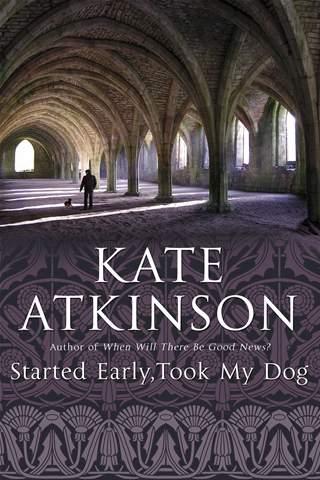
Started Early, Took my dog – Kate Atkinson

I’ve just finished reading this book – my first of the Jackson Brodie series – and I’m now determined to read everything Kate Atkinson has ever written.

This is a detective story but it’s incredibly clever in the way the fully-developed characters’ stories intertwine and their preoccupations clash and collide. Tracy, an ex-cop, sees a child being mistreated in the street and, bizarrely, offers to buy her on the spot. At the same time, private detective Jackson Brodie witnesses a brutish man kicking his dog and – on a similar whim to Tracy – snatches the whippet away and takes care of it.

The themes here are largely about responsibilities to protect. There are characters who can’t have children, characters who have lost children, missing children and misplaced children. Not to mention the dog. Each character has a different and convincing motive for their actions and when we look back into the past, we see the reasons behind each motion is deeply set in a disturbing incident from 1975.

This is not your ordinary detective novel. Kate Atkinson uses straight forward language flecked with perfect descriptions. When investigating adopted Hope McMaster’s past, for a long time Jackson finds nothing, her “past was all echoes and shadows, like looking into a box of fog.” And as different moments are seen from different points of view, the characters refer to what they experience in terms of what they know, often reflecting back on earlier descriptions.

Kate Atkinson deftly switches between character voices to give a well-rounded sense of scene and a clear picture of this particular part of society – crooked cops, prostitutes, aging television stars – all of whom play a crucial role in the outcome.
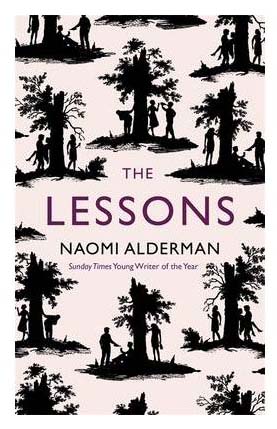
The Lessons – Naomi Alderman

By the end of this book I was trying to understand why on earth I could relate to the narrator. I have nothing in common with Oxford student, James who falls in with a crowd beyond his own sophistication and wealth. He lives the life of excess with a ready-made circle of friends and finds – by the end of it – that he’s been in love with both his stable, sensible violinist girlfriend Jess and the over-indulging somewhat chaotic Mark.

The first person narrative reminded me of Fitzgerald’s Nick Carraway in the reflective tone and sense of awe at the people he is mingling with. The great skill in this novel is definitely the characterisation as, although I don’t know people like this, I totally believed in their existence, their reactions and disappointments.

Beyond the Oxford years, life goes on and when tragedy strikes, the characters respond in the same ways they’ve always responded: moving on, dropping out or sticking hopelessly nearby. The novel spans over 10 years of these characters lives but there’s something timeless about them. The lack of references to modern society is subtle enough that, I imagine, any generation would recognise in this their own awkward shift from university to the ‘real world’.

Every moment feels crucial and convincing as James describes relationships, secrets and his own failings to be quite the person he thought he was.

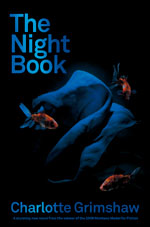
The Night Book – Charlotte Grimshaw

This book has received mixed reviews, some marvelling at Grimshaw’s sparce and satirical prose and others questioning the credibility of characters. The Night Book started its life as a short story (published in The Listener, January 2009) and this remains as the first part of the book. However, you can almost see where it’s been stitched together and, for me, I felt the polished, mysterious, compelling beginning belied the rest of the story.

Set in Auckland, Dr Simon Lampton is battling family problems and an uneasy relationship with his two daughters, one of whom is adopted. Meanwhile, Roza Hallwright – wife of the Hallwright – is battling her own demons and trying to stay out of the lime-light as her husband becomes Prime Minister. Simon and Roza’s connection came as no surprise to the reader but, somehow, it felt that this connection was holding the whole story together. While some characters were clearly based on real-life New Zealand policital and public figures, others seemed flimsy and, at times, embarrassingly stereotypical. Simon flees his home troubles to slum it in South Auckland with poor, solo Mereana and Roza seeks comfort in a shallow friend whose life seems to consist of manicures and getting high.

The underlying idea in this novel was an intriguing one. However, as I didn’t connect with the selfish main characters or really believe in the way they behaved, I was left questioning whether this was a comment on society or just an observation of a small part of it.

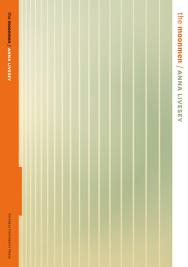
The Moonmen – Anna Livesey

This is a delightful collection of poems. Moving through her own history now, Anna presents poetry on family life, connections and her time in Mid-west America. The final poems refer openly to her mother’s illness and all the moments that have breezed along in the earlier poems seem all the more poignant by the end of the book.

I love the way she speaks to the people in her life through these poems with many ‘characters’ appearing in dedications again and again.

Where Anna’s debut, Good Luck, felt like the clever work of an academic mind, this collection feels satisfyingly personal and reflective.

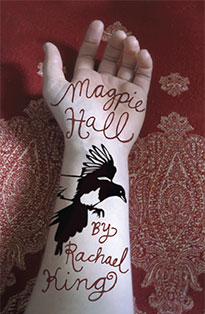
Rachael King – Magpie Hall

There are some really fascinating aspects to this book. I love the idea of collecting as a compulsion and form of preservation and our desire to re-write history – especially when family’s involved.

When Rosemary moves back to her Grandfather’s farm to work on her thesis, she becomes obsessed with the lives of earlier inhabitants. She imagines the fey Dora, first wife of Great-Great-Grandfather Henry, joining the secret world of tattooing as a way of collecting and connecting to Henry’s own obsessions. In her isolation, Rosemary starts to over-identify with Dora and feel the ghostly presence of a more immediate tragic past.

Rosemary’s strongest connection to her late Grandfather was through their mutual interest in Taxidermy, which is another fascinating aspect that is explored. The idea of stuffing rarities to preserve the memory of an endangered species is both tragic and ironic.

There are several self-conscious nods to gothic novels – especially Northanger Abbey and Wuthering Heights – which work in that they’re openly acknowledged through Rosemary’s work, but at times seem a little clunky. The sense of history –  imagined, hoped for and ultimately accepted – brings to light the skeletons and specimens that lurk in our own cabinets of curiosity.

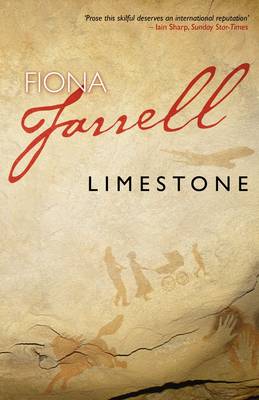
Limestone – Fiona Farrell

This is an intriguing story with threads of mystery, identity, art and stone. Clare Lacey is on a lifelong mission to find her father, who went out for cigarettes one morning and was never seen again. While at an Art History conference in Ireland, Clare continues the search by following a few tenuous leads.

The chapters alternate from third person to first person, always from Clare’s point of view. Through this we see Clare on her present journey and also her as a child in Oamaru. I have no idea why the narrative alternated in this way, but perhaps this is another way in which Fiona Farrell is questioning identity and time. She writes, “In Limestone I wanted to write about time – and in particular how I find myself thinking about time as I become older. On the one hand, there is time as it is experienced in a single human lifetime. One part of this novel is made up of a quest…The other part of the novel is about geological time – and in that sense of time, human lives whether fictional or actual, shrink to a speck, to almost nothing.”

I enjoyed the ‘quest’ nature of the narrative and the connection to the past through Art History, layers of rock and drawing as a way of preserving or exhuming memories.

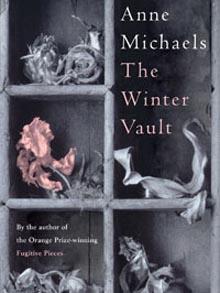
The Winter Vault – Anne Michaels

This is such a remarkable book. The poetic nature of the writing means the novel is driven by ideas and stories but not narrative.

In Egypt, 1964 the temple at Abu Simbel is being dismantled and reconstructed away from rising waters, under the supervision of Avery. This sets the theme of preservation and memory, which continues through each character telling their stories and eventually realising that we can’t recreate or reinvent the past but must retell and retell. Avery’s wife Jean shows us this after her baby is still born and she takes to planting things everywhere – digging into the earth at night – not so much to leave a mark or lay claim but perhaps to create and recreate life where life hasn’t been.

I found this a fascinating novel where I felt challenged to reflect and reread passages but also to learn from the characters’ own reflections on the past. I loved the way talking and sharing stories kept everything alive and the amount of information from engineering to botany, from history to art, meant I felt I was really absorbing facts as well as ideas. The ending pulled all these ideas together into such a satisfying single phrase that sums-up how we must treat the past and our collective memories.

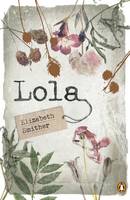
Lola – by Elizabeth Smither

This is a beautifully crafted, poetic and musical novel by one of New Zealand’s most accomplished writers. Lola Dearborn – once of Dearborn and Zander Funeral Services – reaches a kind of loose end in her life where reflective curiosity prevails. This leads to very little action plot-wise, but a lot of introspective and beautifully articulated moments.

Surrounded by death, due to the persistent family business, the theme is used as symbolism with poignant scenes set in the pet cemetery, widows in need of comfort, desperate fathers of still born babies and wilting flowers at grave sites. There’s also a possible echo of the stages of grief as the main characters reach a final sense of amicable acceptance in their relationships with each other.

The characters are single-minded in their goals. The “preposterous” Luigi follows Lola with timidity and unrequited affection while she befriends the lively Sylvester Quartet and Lola tries romantically to live in a hotel in Napier, leaving the unremitting Charles to declare his intentions from afar.

Music works as a structural and thematic device in the novel, always coming back to that which flows or lingers and only rising slowly and carefully to a crescendo when the characters’ worlds start to slide together.

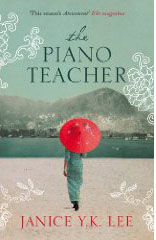
The Piano Teacher – Janice Y.K Lee

This is an intriguing novel, set in a place I know little about. I enjoyed the insight into both the political and personal aspects of Hong-Kong during and post WWII. The story switches between 1943 and 1953 and follows the two lovers of Englishman, Will Truesdale: One a Eurasian socialite and the other the English piano teacher for the well-to-do Chen family. The differences between these women are great but by the end we feel that all characters are guilty of a kind of betrayal. As Victor Chen says, “in times of war, many decisions are made, and things are done without the benefit of reflection.” Many secrets are held and revealed and what is acceptable in one family could be devastating to another.

Pocket Edition – Geoff Cochrane

Victoria University Press, 2009

This slim volume of poetry is Haikuesque and utterly Cochrane. He has such an impressive way of turning small moments into larger queries, memories and references to worldly themes. Each line is crafted to perfection and Cochrane’s forms vary pleasingly from short imagist poems to prose to verse and back again, always acknowledging the dark and the light of life. With reference to Basho and Buddha, Baudelaire and Baxter, this feels like a satisfying homage to poetry itself.