…. save yourself from these general themes and seek those which your own everyday life offers you; describe your sorrows and desires, passing thoughts and the belief in some sort of beauty – describe all these with loving, quiet, humble sincerity, and use, to express yourself, the things in your environment, the images from your dreams, and of your memory.
Tuesday Poem – North American haiku
Like melting snow
my landscape changes
with constant warmth
Morning malaize
that lasts
until sunset
Your vibrations of sleep
lull me
to a safer place
In coastal forest
a golden light
ascends
Too much depends
on the way you look at me
how you respond
And then it snowed
and it felt okay
to be so cold
Like sparks from a new years’ bonfire
I’ll glow, rise
vanish


Tuesday Poem – Villanelle at Twilight
I’m always short-sighted at twilight
the city blurs and yet I remain clear
in the dusk of my fading eyesight.
Edges halo and hues will highlight
my squinting vision, my deciphering stare.
I’m always short-sighted at twilight.
Focus on keeping thoughts upright
beaming faces beam only when near
in the dusk of my fading eyesight.
The evening greys remain still, bright
and the thrill of late birds I can hear
but I’m always short-sighted at twilight.
My pulse is the flickering street light
the haze is diffusing my fear
in the dusk of my fading eyesight.
Auburn tinted with dark grey and night
I walk, I glow, I peer
I’m always short-sighted at twilight
in the dusk of my fading eyesight.
© Saradha Koirala 2009
Tuesday Poem – The cat teaches me about death
Not by killing or through her own fragility
by bringing in lizards from the garden.
Play things. Hidden under the rug
she gives them away
with her sniffing interest.
Mostly I coax them onto the dustpan
to carry gently outside. Or I find them later
dusty in corners and stiff.
Heads curled under
tails missing
light.
So light the breeze takes them
before I make it to the rose bush.
© Saradha Koirala 2009
Lola – by Elizabeth Smither
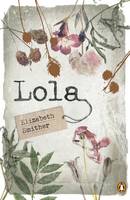 This is a beautifully crafted, poetic and musical novel by one of New Zealand’s most accomplished writers. Lola Dearborn – once of Dearborn and Zander Funeral Services – reaches a kind of loose end in her life where reflective curiosity prevails. This leads to very little action plot-wise, but a lot of introspective and beautifully articulated moments.
Surrounded by death, due to the persistent family business, the theme is used as symbolism with poignant scenes set in the pet cemetery, widows in need of comfort, desperate fathers of still born babies and wilting flowers at grave sites. There’s also a possible echo of the stages of grief as the main characters reach a final sense of amicable acceptance in their relationships with each other.
The characters are single-minded in their goals. The “preposterous” Luigi follows Lola with timidity and unrequited affection while she befriends the lively Sylvester Quartet and Lola tries romantically to live in a hotel in Napier, leaving the unremitting Charles to declare his intentions from afar.
Music works as a structural and thematic device in the novel, always coming back to that which flows or lingers and only rising slowly and carefully to a crescendo when the characters’ worlds start to slide together.
Tuesday Poem – 1987
In my performance-best dress of blue gingham, lace trim and full-frill, my hair brushed and cheeks flushed, I scratch at my violin (I only know one tune) to a full room in June on the other side of the world. A fat blue sponge is my shoulder rest and coloured stickers guide my fingers sharp or flat.
My brother watches and shooshes, as I did when he stood. Poe-faced, he read a poem from home and we all laughed at the quardle-oodle-ardle the wardle and the doodle. But his recitation had such conviction and a concert means we’re leaving soon.
We’ve been the only children for miles in this bleak Birmingham borough, this house full of Quakers and travellers. And perhaps in this whole country, where school is punishment, school lunch detention, and singing on the bus not allowed.
We’ll be six and eight forever in the photos we took. Sitting in train stations, standing by landmarks, pointing beneath street signs of places we’ve been, places we’re headed, and those which remind us of home.
Now we must pack our souvenirs: buttons and badges from the British Museum, T-shirts of Buckingham Palace, of Postman Pat, his Royal Mail van and his black and white cat. The poems we wrote in the laundromat.
We arrived in homemade jerseys, homespun and bark-dyed, we’re leaving now in summer, pale faced and dark eyed.
Tuesday Poem – Archaeology
My brother’s been living beneath the bones of Whataitai
a skeleton brought up by a fault line.
He watches rugby at The Realm.
In the morning we take the ferry to Matiu/Somes
and walk along the ridges
never once spotting tuatara.
Mokopuna Island remains in shadow
cast by its own caves.
Kakariki fly over the gun emplacement
where we sit and eat sandwiches
among the scattered remains of a seagull.
© Saradha Koirala, from Wit of the staircase (Steele Roberts, 2009)
Tuesday Poem – The Mariner’s Compass
by Simon Armitage
Living alone, I’m sailing the world
single-handed in a rented house.
Last week I rounded the Cape of Good Hope,
came through in one piece;
this morning, flying fish
lying dead in the porch with the post.
I peg out duvet covers and sheets
to save fuel when the wind blows,
tune the engine so it purrs all night
like a fridge, run upstairs
with the old-fashioned thought
of plotting a course by the stars.
Friends wave from the cliffs,
talk nervously about the coast-guard station.
Under the rules, close contact
with another soul means disqualification.
© Simon Armitage 1997, from The Whole of the Sky
A Few Don’ts from an Imagiste – Ezra Pound
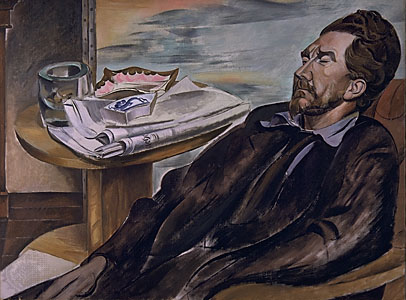
This manifesto is an appendix to a collection of poetry ‘The Imagists’ and is Pound’s expression on how to use language, rhythm and rhyme in the Imagist way. I think his words are sensible advice for good poetry: “Use no superfluous word, no adjective, which does not reveal something.” Imagist poetry is a form that is quite pared-back and concerned with the image itself, but I think looking at the use of adjectives in a poem is a good thing and the poet should always be choosing words carefully.
Some of what Pound writes in this essay corresponds well with Dylan Thomas’ Poetic Manifesto, which I have written about in an earlier post. Where Thomas talks about being a ‘craftsman’ and using all the poetic tools available to him, Pound writes:
Let the neophyte know assonance and alliteration, rhyme immediate
and delayed, simple and polyphonic, as a musician would expect
to know harmony and counterpoint and all the minutiae of his
craft… even if the artist seldom have need of them.
I like this and it makes me think of two things: Basho’s “Learn the rules; and then forget them,” and the idea of unconscious competence, which is the finally stage of learning when you no longer have to think about every detail and tool you are using. This would be a wonderful stage to reach as a writer!
The Piano Teacher – Janice Y.K Lee
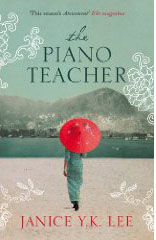 This is an intriguing novel, set in a place I know little about. I enjoyed the insight into both the political and personal aspects of Hong-Kong during and post WWII. The story switches between 1943 and 1953 and follows the two lovers of Englishman, Will Truesdale: One a Eurasian socialite and the other the English piano teacher for the well-to-do Chen family. The differences between these women are great but by the end we feel that all characters are guilty of a kind of betrayal. As Victor Chen says, “in times of war, many decisions are made, and things are done without the benefit of reflection.” Many secrets are held and revealed and what is acceptable in one family could be devastating to another.
 Saradha Koirala