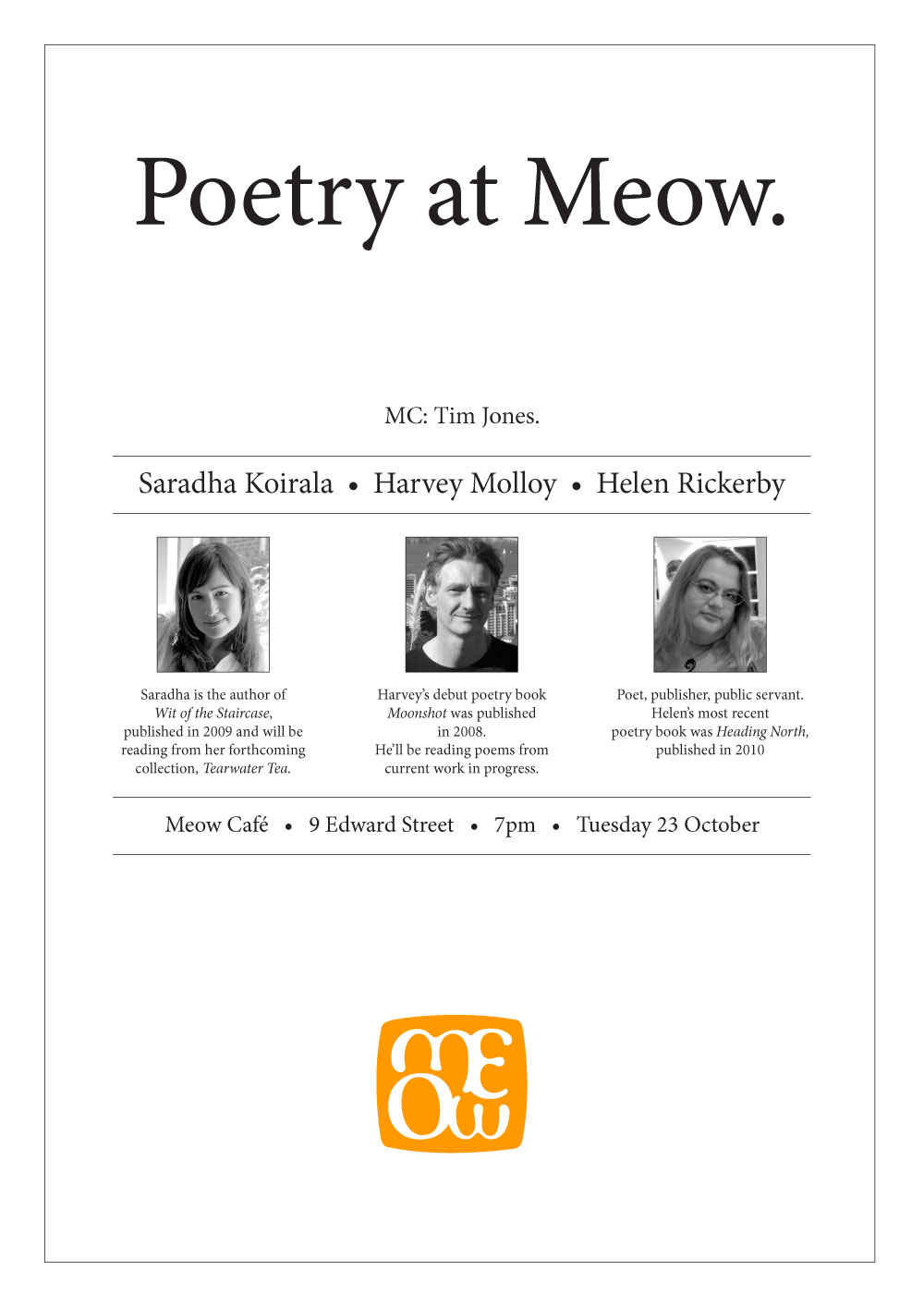
Tuesday Poem – Manly

I thought we could make fun
of the people at the beach
teenage girls in matching togs
like team colours

flocked together families
with self-conscious mothers
tearaway boys

and the cocky men in board shorts
they would probably grow into.

There were loud foreigners
and bikinis on all sorts of bodies.

But instead we watched
the volleyball players and smiled
at children in sunhats.

You spoke not one
cynical word
and splashed your pale limbs
safely between the flags.

more Tuesday Poems here

Tuesday Poem – The First Farewell

Pokhara 1978
After twenty-eight years he’s here
buying me long blacks
and telling stories from before my time.

One day I’ll document pre-history
let him explain the now through the then
take his word for it and keep it close.

But today I only listen. I’ll say it’s only words.
Until one story ends with tears in our eyes
and I realise I’ve been wrong.

There’s more, of course: the dusty unmarked road
of my family’s village, the crowded bus
the blonde woman in jandals and cheap cotton clothes.

The man who will become my grandfather
in his favourite hat, takes calculated steps
as his son leaves his love to travel on.

He walks his son home with a comforting arm
the story ends in tears, but this is just the first
in a lifetime of constant goodbyes.


This poem deserves a bit more editing, but I haven’t posted a Tuesday Poem in ages! It’s all true of course: My dad was recently in NZ for the first time in years and told me a very sweet story about when my mum left Nepal to continue her travels after they first met. Many more meetings and partings ensued. I hope to hear more about these encounters one day too.

Read more Tuesday Poems here

The Sense of an Ending – Julian Barnes

BARNES

A book about aging, regret and the mutability of the past. Middle-aged Tony Webster lives an unremarkable life, quietly getting on with it and content with his lot. But as he looks back on his teenage and university years, things start to replay and shift in his memory.

An unexpected bequest from the mother of an ex-girlfriend sets things unravelling – Tony just “doesn’t get it.” Until on the last page he does.

Barnes is an amazing craftsman, keeping the story smoldering gently to the end. His meditations on aging and remorse – etymologically, Tony points out to “bite again” – ring true, and the fact that the past will eventually bite back becomes “philosophically self-evident.”

This book is proof too that a well-edited and concise piece of writing (the book is only 150 pages) can evoke an as convincing – or even more so – world as a 600 page tome. The descriptions of the adolescent friendships – their rituals, phrasings and preoccupations – in the first half of the novel are utterly plausible and I suspect drawn heavily on Barnes’ own philosophising, self-assured youth.

Perhaps the older man looking back on the mistakes of his youth is an obvious narrative form and indeed I’ve read a few of these recently, but this is far from formulaic or even at all predictable. The story itself is so subtle, it’s the telling of it that is so absorbing.

More here: www.julianbarnes.com

Tuesday Poem – White Lies, by Stanley Motjuwadi

Humming Maggie.
Hit by a virus,
the Caucasian Craze,
sees horror in the mirror.
Frantic and dutifully
she corrodes a sooty face,
braves a hot iron comb
on a shrubby scalp.
I look on

I know pure white,
a white heart,
white, peace, ultimate virtue.
Angels are white
angels are good.
Me I’m black
black as sin stuffed in a snuff tin
Lord, I’ve been brainwhitewashed.

But for Heaven’s sake God,
Just let me be.
Under cover of my darkness
let me crusade.
On a canvas starching from here
to Dallas, Memphis, Belsen, Golgotha,
I’ll daub a white devil.
Let me teach black truth.
That dark clouds aren’t a sign of doom,
but hope. Rain. Life.
Let me unleash a volty bolt of black,
so all around me may know black right.

This poem was given to me by a colleague as a teaching resource.  Stanley Motjuwadi is better known in South Africa as an editor and journalist who lived through the apartheid era and died soon after Nelson Mandela’s release from prison in 1990.

I love the play with symbolism here, my favourite being “That dark clouds aren’t a sign of doom,/but hope. Rain. Life.”

Nelson Mandela’s current ill health has reminded me again of the recentness of apartheid and how people can incite great change. This is also apparent in the existence of The Apartheid Museum which opened in 2001.

More Tuesday Poems here.

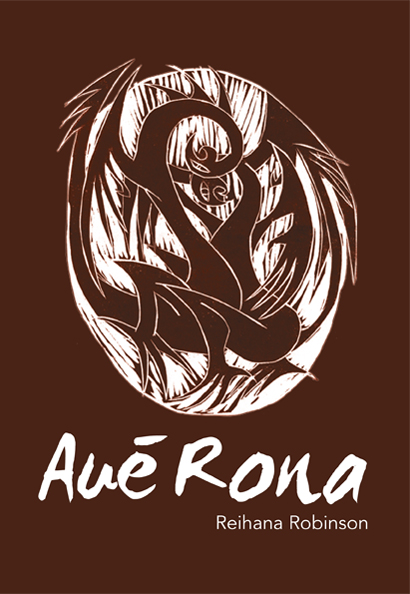
Auē Rona by Reihana Robinson

On Tuesday night I was lucky enough to attend the launch of Auē Rona, by Reihana Robinson. This is a beautifully produced book from Steele Roberts, with stunning images by Noa Noa von Bassewitz.

Launched by the ever-entertaining Roger Steele, this was a true celebration of an amazing new collection. I particularly enjoyed Reihana’s readings (after she revoked her threat to call on random audience members to read on her behalf), in which she embodies the exiled Rona, imagining her anguish at being cast out of the earthly world.

The first poem in the book, “How it all began” retells the legend of Rona, who when out angrily collecting water for her children, curses the moon for the darkness and is pulled up into the sky. Robinson’s retelling in Rona’s voice “Such pitiful pleas – / her thirsty brats” adds a lovely colloquialism “stuff you moon / boil your pea brain with pūhā. / Put your flat head into the cooking pot.” and a killer ending with the moon’s own take on the relationship.

Similarly, there are modern references adding both light and weighty touches to Rona’s story. “Rona does the hula” is full of rich imagery as Rona looks back at her children who have now “grown to pimply adolescence.” A kind of love poem to the moon, Rona recalls the night “…your love slunk a trail, / weaving limbs and heart as if / bat wings were my blanket, / my shawl.”

This is a wonderful collection that brings Rona’s legend alive, re-imagining her love, anger and regret as she grows old away from her family and earth – “that beaten planet.”

Reihana Robinson’s writing has been published in a number of journals including Landfall, Cutthroat, Hawai’i Review, Trout, Melusine, JAAM,  Takahe, Cezanne’s Carrot and Blackmail Press. Her poems have appeared as part of AUP New Poets 3, Auckland University Press, 2008. She lives in the Coromandel.

For more about Reihana and Auē Rona, visit her website: reihanarobinson.co.nz
Tuesday Poem – Painting on Water

drop seeps to a flat abstraction
pulled to a bloom across black-still.

Slow ripple moves to perfection
becoming whole from the inside out.

This is no Monet
squeezed pigments plastered on white

no trapped fleeting, holding still
an inimitable flash.

Here, colour-float spreads swirls
held fast by not quite meeting

capillary motion draws a slow passing
and no lasting proof of the once-hovered hue.


I wrote this poem for last weekend’s Greytown Arts Festival. You can read about our poetic adventures on Mary’s blog and more Tuesday Poems here.

At Midland Park

Grey-hair-and-tweed pulls bits off his burger
throws them out for feathered thieves.

I drip dressing on my skirt as I shoo.

Man in Suit crams a coffee cup in the bin
marked Glass and plastic only. He smiles.

We all do. Bonus sun just when we’d blown
dust off our office heaters, stray hairs from our coats.

Grass imprints disorder on our bare hands.

Inside, the barista is percussionist

crash-cymbal saucers, glockenspiel laid out

or perhaps conductor – back to the crowd
orchestrating lunch.  Rendering sound,

pace through gentle gesture or furious demand.
Pressure of bow, force of breath

 – imbue, extract – intensity of stare.

This is a cafe poem! I’m a bit slow off the mark, but you can probably still buy a book of cafe poems here.

webEatYourWords_cover_low-res_RGB.jpg