Poetic Manifesto: Dylan Thomas

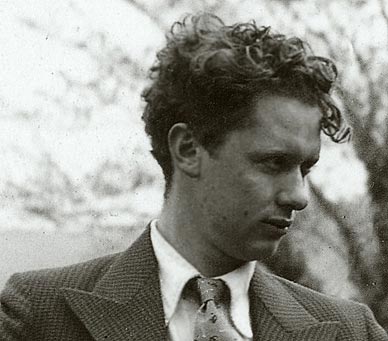
This is Thomas’ responses to five questions put to him by a student and his answers are very interesting in terms of poetics, influence and language.
I like the idea of treating words as malleable materials, taking words out of context and shaping them into poems. In this manifesto, Thomas writes:

What I like to do is to treat words as a craftsman does his wood or stone or what-have-you, to hew, carve, mould, coil, polish and plane them into patterns, sequences, sculptures, fugues of sound expressing some lyrical impulse, some spiritual doubt or conviction, some dimly-realised truth I must try to reach and realise.

How beautiful! Something I’ve always loved about Dylan Thomas is the way he uses words in exactly this way – the sort of ‘soundscape’ quality and rhythm that rolls you along through the pages – so it’s interesting to see it described in his own words.
He talks about having ‘fallen in love with words’ before he could even read them, which would explain the use of sound, rhythm and rhyme in his poetry and prose. It’s interesting too to think about ‘triggers’ and how sounds of words can incite one to write a poem – even just a single word.
I love when Dylan Thomas is writing about his early works, that he thought them to be wonderfully original things, “like eggs laid by tigers”. It’s just a lovely description of one’s own creation: something so new and precious and unimaginably rare!
Thomas goes on to answer a question about the deliberate nature of his use of rhyme, rhythm and word-formation. Personally, I think these things should always be deliberate and even when seeming accidental are surely deliberate on some level of consciousness. I mean, sometimes things ‘just sound good’ or ‘right’ that way, but usually it’s because of the measured rhythm or careful choice of words.
Thomas says:

I am a painstaking, conscientious, involved and devious craftsman
in words…I use everything and anything to make my poems work
and move in directions I want them to: old tricks, new tricks, puns,
portmanteau-words, paradox, allusion, paronomasia, paragram,
catachresis, slang, assonantal rhymes, vowel rhymes, sprung rhythm.

Needless to say I found the footnote to this very useful in defining some of these terms! I love that Dylan Thomas used every device possible and this is taking the deliberate use of rhyme etc to the extreme.

I read poetry to be inspired, moved, surprised, taken somewhere new, to see things from a different angle… and I am happy to be challenged a little when reading. Dylan Thomas says, “I, myself, do not read poetry for anything but pleasure. I only read the poems I like.”
Pocket Edition – Geoff Cochrane

Victoria University Press, 2009

This slim volume of poetry is Haikuesque and utterly Cochrane. He has such an impressive way of turning small moments into larger queries, memories and references to worldly themes. Each line is crafted to perfection and Cochrane’s forms vary pleasingly from short imagist poems to prose to verse and back again, always acknowledging the dark and the light of life. With reference to Basho and Buddha, Baudelaire and Baxter, this feels like a satisfying homage to poetry itself.

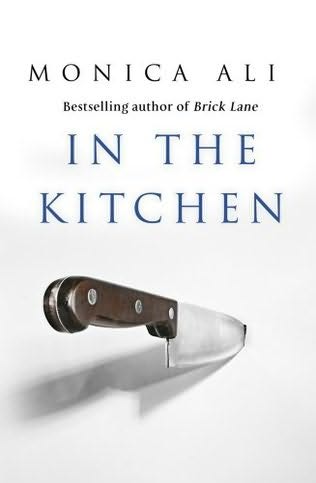
In the Kitchen – by Monica Ali

Chef Gabriel Lightfoot is not the most likeable of protagonists. When a kitchen porter is found dead in the bowels of the hotel where he works, Gabriel’s life plummets steadily. He’s cheating on his partner, resenting his dying father and struggling to tolerate his kitchen staff. I absolutely loved Ali’s debut Brick Lane as the characters and world she’d created were so plausible – the imagery and use of language fitted so convincingly with the main character struggling to find her way in London. Although In the kitchen didn’t grab me in quite the same way, it was a good read with some humourous moments. Things turn out ok for Gabe in the end but, because I found him hard to connect with, I could easily have left him wallowing in his own messy circumstances.

Echolalia

This morning’s northerly
throws death out in my path
a tiny carcass blown from a rubbish bag
a broken bird
at the bottom of a plate glass window.

A paper bag twists itself into the gutter
a butterfly has its wings torn off.

An old man walks into a bar
moving like shaking out a rug
he smells of wood-smoke and rain.
No
like wet logs burning.

I think of houses I’ve visited
with apple cores browning under beds

a cat licking the ends of breakfast
off a bowl in the sink
and the use of words I wasn’t allowed
words I wouldn’t dare use
and words I’d never heard before.

© Saradha Koirala. First published in Moments in the Whirlwind, New Zealand Poetry Society, 2009

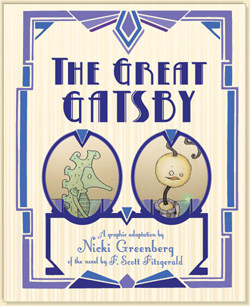
The Great Gatsby: A graphic adaptation by Nicki Greenberg

This classic novel is given new life in graphic form. Although Nick, Daisy, Tom and Gatsby become inhuman creatures, Fitzgerald’s characters are true to form in all their tragic grandeur. I love the original and was delighted by this version. The graphics are quirky and poignant. Set out like an old photo album, Nick Carraway narrates with an almost nostalgic tone, at times destroying and then restoring the snapshots that make up the tale. The Great Gatsby is so often defined as a “jazz age classic”  and this has been captured through the beauty and flow of Fitzgerald’s words and the movement and use of space across each page.

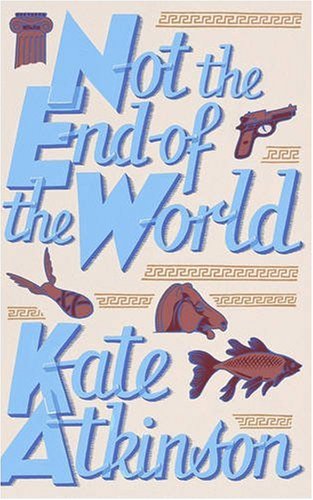
Not the End of the World – by Kate Atkinson

Kate Atkinson is brilliant. This book of short stories reveals itself to be more like a series of vignettes, tied together by shared moments and recurring characters. Some of whom include the sandal-wearing English teacher (particularly cringe-making), the evil twin of a television reviewer and a giant cat called Gordon.
These stories all have a twist of fantasy and surreality, but the characters are convincing and the situations are often painfully and hilariously believable. The connections between stories are subtle enough to feel clever and surprising, yet strong enough to build each character into a real person.