The Country is Yours – Contemporary Nepali Literature

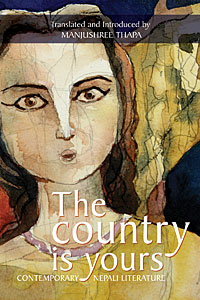
While in Nepal recently I was keen to find some Nepali literature. The Country is Yours is a collection translated into English by Manjushree Thapa and featuring stories and poems written in the period leading up to and after the re-establishment of democracy in 1990. The feeling is of renewed self-expression and the works cover not only the sense of emerging political freedom but also “more personal visions of transcendence”.

Thapa says in her introduction “This collection should be taken by those unfamiliar with Nepali literature, as an introduction to contemporary voices,” but stresses that “this book does not offer an authoritative overview of the literature of this period. It is, instead, a personal collection of works that moved me and compelled me to translate them.”

The book is divided into sections to cover the four themes: ‘The Perplexity of Living’; ‘The Right to Desire’; ‘The Imminent Liberation’ and ‘Visions’.

Here’s a poem from the second section by Benju Sharma:

Come

Spring
come
in the lips of tender buds
Come red and fiery
sprouting passion
on cheeks ripened by
the scarlet of rhododendrons
Make me soar
on the wings of horses
that whinny and neigh far above
the purple jacaranda trees
Binding me in the clasp
of velvety tips of green grass
slash through all these bars
with your sword
and seat me in a honeycomb
overflowing with
the elixir of bees
Set me on a dinghy
adrift on swelling waves,
and cover me with
the embrace of the entire sky
Tie me with the mighty limbs of
boughs and branches
A few outcroppings
you might have to level
A few craters
you might have to fill
So come
gathering the force of a bulldozer
Come as ferocious Bhairava*

(*the fierce manifestation of Shiva associated with annihilation.)

Poetry, the creative process and mental illness

By Alex Hudson
BBC NEWS

7 February 2011 Last updated at 10:29 GMT

Byron was “mad, bad and dangerous to know” according to one lover, Keats was driven to distraction by obsessive love and Sylvia Plath ended her own life.

Depression, madness and insanity are themes which have run throughout the history of poetry.

The incidence of mood disorders, suicide and institutionalisation was 20 times higher among major British and Irish poets between 1600 and 1800 according to a study by psychologist Kay Redfield Jamison.

In other words, poets are 20 times more likely to end up in an asylum than the general population.

Science has puzzled to explain it. One recent study found similar brain patterns in artists at work to those of schizophrenics. Another study found that creative graduates share more personality traits with bipolar patients than less creative ones.

As far back as the mid 1800s, Emily Dickinson stated that “much madness is Divinest sense” and Edgar Allan Poe questioned “whether madness is or is not the loftiest intelligence”. 

 So what is it about poetry that seems to attract those more likely to suffer a mental disorder?

“If you’re a creative person, then poetry is a great format because it’s short,” says poet Luke Wright. “You can do almost anything with it and it’s not like a novel – it’s not going to take you years and you have no idea if it’s going to be any good.”

Poetry allows for the nuance of language and the different way someone sees the world.

“I think you’ve always got to be interested in a slightly different aspect of the universe to even want to pick up a pen and analyse the world through poetry,” says spoken word artist Laura Dockrill.

“I think our brains are big scribbles and always active. Because you can write about anything, you’re always on the go – trying to put something to your Velcro head hoping it will stick on.

“Part of poetry is making words do more work that they usually should do and so you’re looking for every angle of what a word might mean and so your brain starts working like as well – over-analysing everything and zooming in to minute detail.”

Read More

Tuesday Poem – Patan Ghar

My grandparents’ house once stood
mud and thatch, a stone’s throw
in a pool of progression.

The resulting rings told of new technologies,
expanding family
a rippling out of concrete houses
evolution
in a small plot of land.

A push over though,
and structured like a dunked biscuit.
History worth preserving, perhaps
but no longer a liveable home.

We stay on the same spot
some floors up
in my father’s unfinished building.
Solid and warm
in handmade bricks and steel

its foundations are deep enough
for storeys to come
its foundations strong in the stories past.

© Saradha Koirala 2011

I have just returned from Nepal where my dad is building a house (ghar) on the family land.

Tuesday Poem

Farewell to Harvey McQueen

I feel very lucky to have met Harvey at the book launch of his lovely dedication to New Zealand Poetry, These I have Loved. Here is The Last Post of his thoughtful, thought-provoking and warm-hearted blog.

Haere Ra

Farewell to Hiruharama –
The green hills and the river fog
Cradling the convent and the Maori houses –

The peach tree at my door is broken, sister,
It carried too much fruit,
It hangs now by a bent strip of bark –

But better that way than the grey moss
Cloaking the branch like an old man’s beard;
We are broken by the Love of Many

And then we are at peace
Like the fog, like the river, like the roofless house
That lets the sun stream in because it cannot help it.

Tuesday Poem – Harbour (1), by Bernadette Keating

Harbour (1)

Dead photo surface,
reminiscence, and widowed stains of shadow matter.
Metalucent cut waves and forcing
to fold into brine like pleating.

Like something that is obvious –

Carson McCullers by the sea.
Roberto Bolano by the sea.
Yukio Mishima by the sea.
Leslie Scalapino by the sea.
Tennessee Williams by the sea.

The smells that the weather has perpetually
trapped and matured. Greenhouse green
all the time.

The lean worst place is
where my parents
took us for long walks the
wind inviting fury as a friend
and my cheeks. Salty distaste and stinging.
They’d say ‘a walk along the
South Coast’ – the same word with different knowledge.

Fluid naming, no point of reference, this
water is all the same, but I don’t
mind having shags pointed out to
me.
Favourable conditions to muster sea animals in
tepid rivulets off beaks can drip
and dip my toes in twice, too familiar.

Brother who throws the seaweed
at my face, “you’re dead.” Quiet lapping
and just so, thankless dunes loom
whom never get wet.


Bernadette says this is part of three poems about Wellington Harbour, tied to experiences from her childhood and the present.

I love the ghostly feel of the past drifting in and out of photo-like images.


Tuesday Poem

Whisper down the lane – fun with synonyms

I’ve just come up with a synonym game based on ‘Whisper down the lane’ – it’s complete nonsense really but fun if you like to play with words and test your vocabulary.


Start with a phrase in the form of:

The adjective adjective noun verbs adverbly with adjective noun.


It’s good if it makes a bit of sense but the excessive use of adjectives will mean it always sounds OTT.


e.g The large green sprout grows ruthlessly with callous regret.


Now pass it to a friend (or you can play this solo) whose job is to replace each of the main words with a synonym.


e.g ‘large’ could mean ‘fat’; ‘green’ sometimes means ‘immature’; a ‘sprout’ could be a ‘spring’ etc.


so the phrase might become:


The fat immature spring breeds pitilessly with uncaring lament.


Nonsense! But keep going!


The chubby young helix rises heartlessly with cold grief.


Again!


The plump little curl climbs cruelly with icy pain.


You can pass this around until you’ve run out of synonyms or by some unlikely coincidence you come back to the original phrase – although chances are this will just become sillier and sillier:

The flabby slight twist mounts meanly with frozen hurt.


The loose minor coil scales shamefully with solid harm.


The wobbly negligible spiral balances shockingly with hard injury.


Uh oh!


Tuesday Poem – Advice

For Jan

She says it’s human nature to ruffle things up
just when they’ve settled down nicely.

It’s how we evolved, she says
how we covered the planet and wiped out other species

who contentedly lived their lives.
Don’t be so hard on yourself, she says.

Early civilisations crossed the Bering Strait
an arduous journey based on nothing but hope.

Some stopped in Alaska, happy to find food,
a constant shoreline

but the restless ones,
the ones who couldn’t bear to sit still

followed curiosity and found South America
made pottery, invented chocolate.

Eventually earned their siestas.
I know, I say, I should lighten up

because what can you say
to a mother who is always right.


Tuesday Poem

Tuesday Poem – ∞

This Möbius strip,
a strip of paper.
Twisted ends
a single-sided surface
not cylinder
nor ring
twisted
ends together.
Not knowing
your Topology
you’d never guess
how Möbius the strip
this strip of twisted paper.
This Möbius Strip.

 Tuesday Poem

Some semi-formed ideas on Karma and Physics

I don’t know much at all about quantum field theory, but there’s something in there about the interconnectedness of all particles, meaning we can’t do anything without inadvertently affecting something else. Or perhaps that’s chaos theory. My actions now cause a chain reaction of unexpected yet somehow predictable events. Newtonian physics suggests something similar. Is it even physics though to suggest that some things just can’t go unnoticed? I interact with enough people on any given day that even the faintest flicker of a smile could have repercussions in the days and homes and lives to come. Religion will tell us this is true too. Almost every religion promises future rewards for present moments of good. The Bible tells us to “love your enemies, do good to them, and lend to them without expecting to get anything back. Then your reward will be great,” as in every action has an equal and opposite reaction.

I haven’t yet taken on an entire set of religious beliefs but there are many aspects of different religions that appeal. The idea of karma, for example, is a liberating one. I have less need to seek revenge on wrong doers or to wish ill on those who harm others because the universe judges in the most righteous of ways. Less cosmically, we have justice: other humans deciding how other humans should be treated based on rules and actions. But beyond our control is karma: you just don’t get away with being an asshole. We can feel smug imagining its possibilities and believing that eventually everyone will get their comeuppance. This isn’t necessarily incompatible with what we know of the laws of physics and common sense either. Someone who beat you up at school possibly grew up only knowing violence as a way of solving problems. As they continued through life with this attitude they found they were isolating people, missing out on the jobs they wanted and ruining potentially loving relationships. They got their comeuppance. I like to think it works with particle theory too: We’re all connected to each other and the universe feels all our various shifts and shuffles, every movement and push whether destructive or constructive.

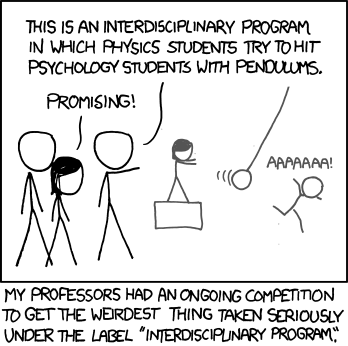
Newton’s third law is often demonstrated with a pendulum swing. The force put in to send it one way means it will swing back with equal magnitude in the opposite direction. This can be useful when thinking about emotions and why when you feel strongly about someone or something you often feel extremes of both love and hate. Emotionally, I have a wide arc to my swing. I can feel great joy and as a counter balance must also be prepared to feel great sorrow. I could never be someone who hangs steadily and calmly in the middle, keeping upright and never ticking too far in one direction for fear of the reactionary tock in the other. But this can be a great affliction at times and I have to make sure I feel everything on the way from one end of my arc to the other. Making sure I enjoy the ride between and feel every emotion that makes me human. But if some of these feeling are just the swing back from earlier feelings, how can I trust them? And am I even in control?

Tuesday Poem – From the kitchen

I watch great gulls,
beaks curved like peeling knives,
pull mussels off the rocks
and drop them from a hover above the road.

The meat inside must be worth the work,
scraps of lunch surely remain unguarded
at the Fisherman’s Table.

In the harbour a looming ferry
tilts yachts in its wake.
While a loamy garden’s succulents
grow tough.

Tuesday Poem