Tuesday Poem – Treasure

I’m drawn again to my mother’s jewellery.
Not those she’s owned – oversized earrings of the eighties,
hand-crafted bracelets from Asian markets
or the chunky silverwork she made in the seventies –

but the ring she had modified for my twenty-first:
a silver cage added to her wedding band
holding a blood-red garnet from Kashmir
during travels before my time.

I’ve been wearing the earrings
gifted at another significant date
one lost, confessed, replaced
they whistle gently, spinning as I walk.

There were garnets again at graduation
two small studs and a matching one
threaded on a thin silver chain,
delicately linking the past to my newly laid path.

The recycled glass pendant we bought together
a memento of a strenuous tramping trip.
Mine concentric rings of wine bottle necks
while hers is more elegantly crafted.

I thought the carelessly dropped list last Christmas:
Saradha, necklace would have spoilt the surprise
but I didn’t know how the string of cut glass would
send prisms of blue and amber around every room I’m in.

And now this cupid cameo in old fashioned green.
She’d watched my reaction carefully to help her choose
when we shopped together, our gentle patter like precious stones
or the sound a timpani might make if you only knew it by name.


© Saradha Koirala 2011

Tuesday Poem

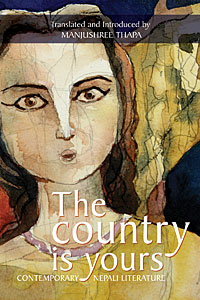
The Country is Yours – Contemporary Nepali Literature

While in Nepal recently I was keen to find some Nepali literature. The Country is Yours is a collection translated into English by Manjushree Thapa and featuring stories and poems written in the period leading up to and after the re-establishment of democracy in 1990. The feeling is of renewed self-expression and the works cover not only the sense of emerging political freedom but also “more personal visions of transcendence”.

Thapa says in her introduction “This collection should be taken by those unfamiliar with Nepali literature, as an introduction to contemporary voices,” but stresses that “this book does not offer an authoritative overview of the literature of this period. It is, instead, a personal collection of works that moved me and compelled me to translate them.”

The book is divided into sections to cover the four themes: ‘The Perplexity of Living’; ‘The Right to Desire’; ‘The Imminent Liberation’ and ‘Visions’.

Here’s a poem from the second section by Benju Sharma:

Come

Spring
come
in the lips of tender buds
Come red and fiery
sprouting passion
on cheeks ripened by
the scarlet of rhododendrons
Make me soar
on the wings of horses
that whinny and neigh far above
the purple jacaranda trees
Binding me in the clasp
of velvety tips of green grass
slash through all these bars
with your sword
and seat me in a honeycomb
overflowing with
the elixir of bees
Set me on a dinghy
adrift on swelling waves,
and cover me with
the embrace of the entire sky
Tie me with the mighty limbs of
boughs and branches
A few outcroppings
you might have to level
A few craters
you might have to fill
So come
gathering the force of a bulldozer
Come as ferocious Bhairava*

(*the fierce manifestation of Shiva associated with annihilation.)

Poetry, the creative process and mental illness

By Alex Hudson
BBC NEWS

7 February 2011 Last updated at 10:29 GMT

Byron was “mad, bad and dangerous to know” according to one lover, Keats was driven to distraction by obsessive love and Sylvia Plath ended her own life.

Depression, madness and insanity are themes which have run throughout the history of poetry.

The incidence of mood disorders, suicide and institutionalisation was 20 times higher among major British and Irish poets between 1600 and 1800 according to a study by psychologist Kay Redfield Jamison.

In other words, poets are 20 times more likely to end up in an asylum than the general population.

Science has puzzled to explain it. One recent study found similar brain patterns in artists at work to those of schizophrenics. Another study found that creative graduates share more personality traits with bipolar patients than less creative ones.

As far back as the mid 1800s, Emily Dickinson stated that “much madness is Divinest sense” and Edgar Allan Poe questioned “whether madness is or is not the loftiest intelligence”. 

 So what is it about poetry that seems to attract those more likely to suffer a mental disorder?

“If you’re a creative person, then poetry is a great format because it’s short,” says poet Luke Wright. “You can do almost anything with it and it’s not like a novel – it’s not going to take you years and you have no idea if it’s going to be any good.”

Poetry allows for the nuance of language and the different way someone sees the world.

“I think you’ve always got to be interested in a slightly different aspect of the universe to even want to pick up a pen and analyse the world through poetry,” says spoken word artist Laura Dockrill.

“I think our brains are big scribbles and always active. Because you can write about anything, you’re always on the go – trying to put something to your Velcro head hoping it will stick on.

“Part of poetry is making words do more work that they usually should do and so you’re looking for every angle of what a word might mean and so your brain starts working like as well – over-analysing everything and zooming in to minute detail.”

Read More

Tuesday Poem – Patan Ghar

My grandparents’ house once stood
mud and thatch, a stone’s throw
in a pool of progression.

The resulting rings told of new technologies,
expanding family
a rippling out of concrete houses
evolution
in a small plot of land.

A push over though,
and structured like a dunked biscuit.
History worth preserving, perhaps
but no longer a liveable home.

We stay on the same spot
some floors up
in my father’s unfinished building.
Solid and warm
in handmade bricks and steel

its foundations are deep enough
for storeys to come
its foundations strong in the stories past.

© Saradha Koirala 2011

I have just returned from Nepal where my dad is building a house (ghar) on the family land.

Tuesday Poem